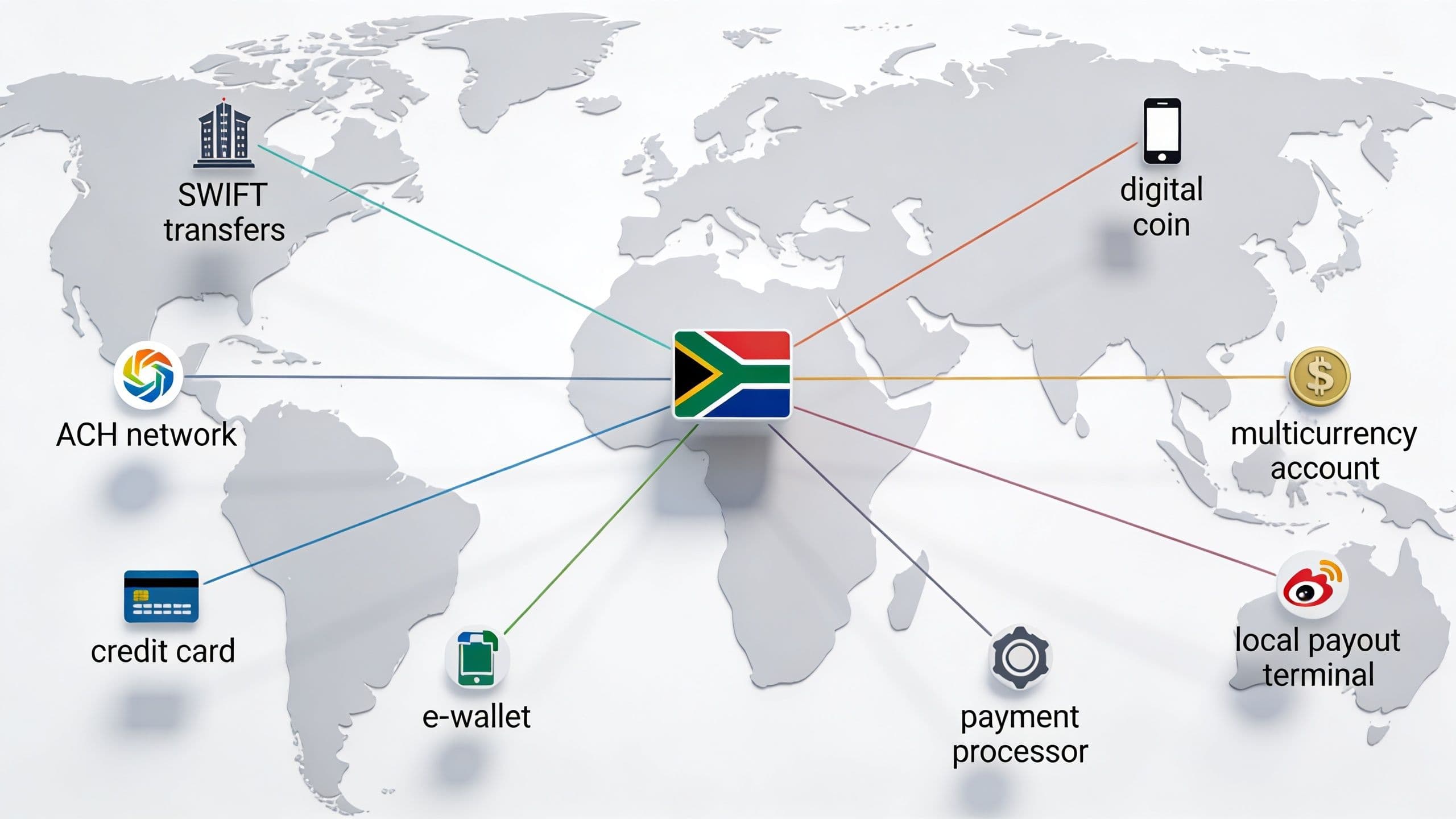
Your supplier in Europe wants payment today. Your bank portal offers a SWIFT transfer, but before you approve it, you can already see three pressure points. Bank fees, a marked-up exchange rate, and no firm answer on when the funds will arrive. If the payment gets held for compliance checks or routed through multiple banks, your team spends the next few days answering emails instead of closing the month.
That is a common operating problem for South African businesses. Cross-border payments affect cash flow, supplier trust, landed cost, and compliance workload all at once. The friction rarely sits in one place. Part of it sits in bank charges, part in FX spread, part in paperwork, and part in the simple fact that different payment types solve different problems.
A business paying a factory in China, collecting export proceeds from the UK, reimbursing a contractor in Kenya, and settling marketplace payouts in dollars should not use one method for every transaction. The wrong payment rail adds cost in obvious ways, then adds more cost in less visible ones. Treasury loses control of timing. Operations lose visibility. Finance spends more time reconciling exceptions.
South African firms also have local requirements to work through. Exchange control reporting, FICA checks, supporting documents, and tax treatment can all affect how a payment should be structured and which provider is practical. A method that looks cheap on paper can become expensive once delays, manual intervention, and compliance queries start stacking up.
The better approach is to choose payment tools by use case.
Some payments need global reach and bank-grade formality. Some need speed. Some need tighter FX control. Some need built-in automation for high transaction volumes. That is why this guide compares the main types of cross-border payments side by side, with a South African lens, so finance teams can decide what to use, when to use it, and where a modern option such as Zaro can reduce cost and admin without creating new risk.
1. International Bank Transfers (SWIFT)
A Cape Town importer approves a supplier payment on Tuesday, expects goods to be released on Thursday, then spends Friday chasing proof of funds because the transfer is still moving through intermediary banks. That is the experience of SWIFT for many South African businesses. It remains the standard option for formal international trade, but it often creates friction on timing, cost visibility, and follow-up work.
SWIFT is still widely used because it reaches almost every banking market that matters. If you are paying a manufacturer in Germany, settling a high-value invoice in China, or receiving funds from a US customer that insists on a bank wire, SWIFT is usually accepted without debate. That matters in supplier relationships where counterparties care as much about familiar banking rails as they do about payment itself.
The trade-off is operational drag. A SWIFT payment is a secure bank-to-bank instruction, but settlement can still depend on correspondent banks, cut-off times, manual checks, and the quality of the payment data submitted at the start. For South African firms, local exchange control reporting and supporting documents can add another layer if the transaction is queried or coded incorrectly.
Where SWIFT still makes sense
Use SWIFT for payments where formality, reach, or transaction size matters more than speed.
That usually includes:
- high-value supplier payments
- trade transactions where the beneficiary only accepts bank wires
- payments into countries or banks with limited fintech coverage
- receipts from overseas customers that pay only through traditional banking channels
It is also a sensible option where audit trail matters. Bank wires are familiar to auditors, treasury teams, and overseas counterparties. For some businesses, especially importers and exporters dealing with established banks, that familiarity reduces commercial friction even if it does not reduce cost.
Where South African businesses get caught out
The biggest mistake is using SWIFT for routine payments that do not need it.
If you are paying recurring contractor invoices, lower-value supplier bills, or regular cross-border operating expenses, bank wires often create unnecessary cost. The sending fee is only one part of the bill. FX margin, correspondent charges, lifting fees at the receiving end, and internal admin time all add up. Finance teams also lose time tracing payments, matching deductions, and explaining why the beneficiary received less than expected.
There is also a compliance angle. South African businesses need the payment purpose coded correctly and the supporting documents ready when required. If those details are incomplete, the payment can stall or trigger follow-up from the bank. A payment method that looks acceptable on paper can become expensive once finance staff are pulled into manual repairs.
Practical rule: Use SWIFT where counterparties, value, or corridor constraints justify it. Do not use it by default.
How to use SWIFT without wasting money
A few controls make SWIFT more manageable:
- Get the full charge structure up front: Ask for the FX rate, sending fee, and any expected intermediary or beneficiary charges before approval.
- Confirm beneficiary details line by line: Account name, SWIFT/BIC, branch details, and intermediary bank fields need to match exactly.
- Build in time for cut-offs and compliance checks: Urgent payments sent late in the day or with weak documentation are more likely to miss value dates.
- Use it for the right payment size: Reserve SWIFT for transactions where reliability of acceptance matters more than speed or fee efficiency.
- Track deductions on receipt: If suppliers complain about short payment, check whether charges were shared, not whether the invoice was underpaid.
For many South African businesses, SWIFT stays in the payment mix. It is dependable for certain use cases, especially larger trade payments and formal bank-led flows. It is rarely the cheapest or easiest option for everyday cross-border operations, which is why finance teams usually get better results when they pair it with faster, more transparent tools for recurring payments.
2. Fintech Payment Platforms (Real-Time Solutions)
It is 4 p.m. in Johannesburg. A supplier in the UK is waiting, payroll support for remote contractors closes in two hours, and finance still cannot tell what the final FX cost will be if the payment goes through the bank. That is the problem fintech payment platforms were built to solve.
For South African businesses with frequent cross-border payments, these platforms usually beat traditional bank processes on speed, pricing visibility, and day-to-day admin. The fundamental benefit is not just faster settlement. It is better control over the full payment workflow, from quote to reconciliation.

Why fintech platforms suit recurring cross-border flows
Banks still make sense for some high-value or documentation-heavy payments. But for monthly supplier runs, contractor payouts, software subscriptions, and export collections, fintech platforms are often the more efficient tool.
A good provider gives finance teams clear FX pricing before approval, faster delivery to common corridors, and fewer manual handoffs. That matters in South Africa, where exchange control checks, supporting documents, and internal sign-off can already slow the process. If the payment rail adds more friction on top of that, the cost shows up in staff time as much as in bank fees.
The strongest platforms also improve treasury discipline. Holding foreign currency balances, timing conversions properly, and batching payments can reduce avoidable FX losses. Used badly, those same features can create exposure. Used well, they give finance teams more room to manage working capital.
Where they work best
Fintech platforms are a strong fit for:
- Recurring supplier payments where speed and fee transparency matter more than legacy bank relationships
- Contractor and freelance payouts across multiple countries
- Export businesses that need to collect in foreign currency and convert on their own schedule
- Mid-market finance teams that want approval flows, user permissions, and cleaner audit trails
For many South African companies, this is the category that removes the most routine payment pain.
What to check before you switch
Do not judge a platform on the dashboard alone. Judge it on the full operating model.
- Total landed cost: Check the FX spread, transfer fee, funding cost, and any receiving charges together
- South African compliance support: Confirm how the provider handles documentation, reporting, and the information your bank or authorised dealer may still require
- Currency coverage: Make sure the platform supports the corridors and currencies your business uses
- Finance controls: Look for approval rules, user permissions, downloadable reports, and a clean audit trail
- Reconciliation: Test whether references, settlement reports, and account statements fit your accounting process
- Liquidity options: Multi-currency balances help if you have a reason to hold funds. They are less useful if treasury policy requires immediate conversion
Zaro is one example in this category. The practical value is straightforward. South African businesses can hold local and foreign currency balances, see pricing clearly, and move money with less operational drag than a standard bank-led process.
The decision framework is simple. If the payment is repeatable, price-sensitive, and operationally heavy under SWIFT, a fintech platform is often the better choice. If the payment is large, unusual, or heavily document-driven, keep the bank in the mix. The best finance teams do not pick one method for everything. They match the payment rail to the job.
3. Cryptocurrency and Blockchain Payments
A Cape Town company needs to pay a developer in Lagos on a Friday afternoon. The supplier wants funds the same day, the banking cutoff has passed, and nobody wants to wait through a weekend for confirmation. That is the narrow but real space where blockchain payments can make sense.
For South African businesses, crypto is not a general replacement for bank-led cross-border payments. It is a specialist tool. It works best when both parties already understand wallets, the amount is controlled, and the business has a clear process for compliance, approvals, and conversion back into fiat.

Best use cases for crypto payments
The strongest use case is cross-border payouts to contractors, freelancers, or digital service providers who already operate comfortably in crypto. It can also suit crypto-native suppliers, online businesses with international counterparties, and urgent transfers where conventional rails are too slow for the commercial reality.
Stablecoins are usually the only practical option for routine business use. They reduce the treasury exposure that comes with holding or sending volatile assets like Bitcoin or Ether. Finance teams still need to account for wallet custody, transaction records, and local tax treatment, but at least they are not also dealing with sharp value swings between approval and receipt.
Some firms also use payment infrastructure that helps them integrate crypto payments with CoinPay API when they need a more structured operational setup.
The South African compliance issue
Many teams find themselves caught at this stage. The payment may move quickly on-chain, but your internal and regulatory obligations do not disappear. South African businesses still need to think about exchange control treatment, source-of-funds records, counterparty checks, and how the transaction will stand up under audit.
If the finance team cannot explain who was paid, why they were paid, what rate was used, and how the transaction was recorded in the ledger, the speed benefit is not worth much.
Where businesses go wrong
The common mistake is using crypto because it feels faster, without designing the control environment around it. That creates avoidable risk.
A workable policy usually includes:
- Use stablecoins for business payments: They are easier to price, approve, and reconcile than volatile crypto assets.
- Restrict crypto to suitable counterparties: Use it only where the recipient can receive, verify, and convert funds properly.
- Set wallet controls before the first payment: Define who can approve, send, and reconcile transactions.
- Record the fiat value at the time of payment: Treasury, tax, and accounting teams need a clean reference point.
- Plan conversion back to bank money: Leaving balances idle in wallets creates exposure without a business reason.
The trade-off is straightforward. Blockchain payments can cut delay and bypass some of the friction built into traditional international transfers. They also introduce new control, custody, and reporting demands. For most South African companies, that means crypto belongs in the payment mix only for specific corridors and counterparties, not as the default option.
4. Money Transfer Operators (MTOs) and Remittance Services
A Cape Town business needs to pay a field technician in a market where bank access is patchy, the amount is modest, and the money needs to be collected the same day. That is the kind of payment MTOs handle well.
For South African businesses, MTOs are a practical last-mile option. They work best when the recipient needs cash pickup, mobile wallet delivery, or a simple payout process that does not depend on a fully functional banking relationship. I have seen them used for emergency staff support, one-off contractor payouts, and operational reimbursements in regions where a standard bank transfer creates more delay than control.
That does not make them a treasury tool. It makes them a targeted payout method.
The local compliance point matters. A South African finance team still needs a clear reason for payment, recipient verification, source-of-funds support, and records that can stand up in an audit file. If your team cannot match the transfer receipt to the invoice, approval, and ledger entry, the convenience disappears fast.
When MTOs are the right answer
Use MTOs for low-value, time-sensitive payments where reach matters more than rich reporting. They can make sense for temporary workers, field agents, or beneficiaries in countries where branch collection or wallet payout is more reliable than bank settlement.
They are also useful when the recipient profile is informal. Some counterparties can receive funds, but cannot receive them well through the banking system. That is a different problem, and MTOs often solve it better than a bank does.
For teams comparing payout rails, it also helps to understand how businesses integrate crypto payments with CoinPay API when recipients prefer digital wallets over cash collection.
Where MTOs fall short
MTOs are a weak fit for formal supplier payments, recurring accounts payable, and any workflow that depends on detailed remittance data. Fee transparency can also be uneven once you factor in exchange rate margins, payout charges, and collection conditions in the destination market.
Control is the main trade-off. A bank payment usually gives finance teams better audit evidence, clearer beneficiary records, and easier reconciliation. An MTO gives wider payout reach, but often with less structure around reporting and approvals. For a South African business, that usually means MTOs belong in the exception process, not the default payables stack.
A sensible policy looks like this:
- Reserve MTOs for urgent or hard-to-bank recipients: Do not use them for standard supplier settlement if a better-controlled method is available.
- Check payout conditions before sending: Recipient name format, ID requirements, branch availability, and mobile number errors cause avoidable failures.
- Capture full payment evidence: Keep the transfer confirmation, approval trail, business purpose, and FX details with the accounting record.
- Review repeat payments quickly: If the same person or partner is paid more than once, move them to a more structured channel such as a bank transfer, fintech platform, or a service like Zaro where the reporting and reconciliation are easier to manage.
MTOs still have a place in cross-border payments. South African businesses just need to use them for the right job: hard-to-reach recipients, urgent situations, and lower-value disbursements where payout access matters more than process depth.
5. PayPal and Payment Aggregators
A Cape Town business lands a new overseas client, sends the invoice, and gets paid through PayPal because that is what the buyer already uses. The sale closes quickly. Then finance sees the actual settlement amount, the payout delay, and the FX conversion. That is usually the moment these platforms move from a sales convenience to a treasury decision.
PayPal and payment aggregators are often the fastest way for South African businesses to start collecting money internationally, especially in e-commerce, SaaS, digital services, and small-ticket exports. They solve a real commercial problem. Buyers recognise the checkout, card acceptance is already built in, and the business does not need to set up local acquiring relationships in every country.
Where they fit best
These tools are strongest on inbound collections where customer conversion matters as much as payment acceptance. If a buyer in the UK or Europe is more likely to complete a purchase because they trust PayPal or a familiar card checkout, that matters. Lost sales usually cost more than a modest difference in processing fees.
They are less effective when finance needs tight control over settlement timing, FX execution, and reconciliation across a growing volume of transactions. Standard platform rules apply to everyone. South African firms have to work within those rules while still meeting local bookkeeping, tax, and exchange control obligations.
That trade-off needs to be explicit. Aggregators help revenue collection. They do not replace a proper cross-border payments stack.
What usually causes friction
The main risk is not just the headline fee. It is operational control.
A platform can place a reserve on funds, slow payouts after a change in transaction pattern, or request extra account verification at the wrong time. If your business relies on that cash for supplier payments, payroll, or import deposits, the problem shows up immediately.
FX is another pressure point. The conversion rate built into an aggregator can be materially weaker than what you would get through a specialist provider or your bank, especially once volumes increase. For a South African business billing in hard currency, that difference can erode margin.
Practical rules for South African businesses
- Use aggregators where checkout trust drives revenue: They make sense for online sales, subscription billing, and smaller international client payments.
- Model the landed amount, not the listed fee: Include platform charges, FX spread, withdrawal costs, and payout timing in your margin calculation.
- Keep source documents organised: Invoice, proof of delivery or fulfilment, client communication, and refund terms should be easy to produce if the account is reviewed.
- Do not depend on one platform for all collections: A second collection route reduces the risk of a hold disrupting cash flow.
- Move higher-value or repeat B2B flows into a more controlled channel: Once transaction size or payment frequency rises, bank rails, fintech platforms, or a service like Zaro usually give finance teams better visibility and easier reconciliation.
For South African companies, the right question is not whether PayPal or an aggregator is good or bad. It is whether it suits the payment job in front of you. If the priority is conversion and buyer familiarity, it can be the right tool. If the priority is FX control, predictable settlement, and cleaner finance operations, it usually should not be the only one.
6. Trade Finance and Letter of Credit (LC)
A letter of credit isn't just a payment tool. It's a risk-sharing mechanism for trade where trust is still being built, shipment values are significant, or the counterparty sits in a market where open-account terms feel too exposed.
For South African importers and exporters in manufacturing, mining, agriculture, and commodity-linked trade, this still matters. If you're shipping goods that take weeks to move and one side doesn't want to release product or cash first, an LC can keep the deal moving.
What an LC actually solves
The exporter wants certainty of payment if they present the right documents. The importer wants comfort that payment only happens against agreed conditions. The bank sits in the middle and turns a trust problem into a document problem.
That's useful, but it also means paperwork is everything. Most LC pain comes from documentary mismatch, not from the concept itself.
Before using one, brief your operations and shipping teams properly. A payment guarantee doesn't help if the bill of lading, invoice, insurance document, or certificate wording doesn't match the LC terms.
Here's a straightforward explainer for teams that need a visual refresher before opening one:
When to use one and when not to
LCs are best for larger, less frequent, higher-risk trade deals. They're usually overkill for routine monthly supplier payments with an established counterparty.
Operational warning: With LCs, the bank checks documents, not commercial common sense. If the paperwork is wrong, payment can still stall even when the goods are fine.
Use them when commercial risk justifies the admin. Don't use them because someone said they're the “proper” way to trade internationally. In many mature supplier relationships, they slow things down more than they protect you.
7. Direct Bank-to-Bank Transfers and Correspondent Banking
A South African finance team sends a large supplier payment on Monday, expects it to land by Wednesday, and by Thursday the beneficiary is still asking where the money is. The bank can confirm it left. The receiving party can confirm it has not arrived in full. Somewhere between those two points, an intermediary bank has delayed, screened, or deducted charges.
That is correspondent banking in practice.
Banks use correspondent networks to move funds into countries and currencies where they do not hold direct clearing access. For South African businesses, that often sits in the background until a payment goes missing, arrives short, or takes longer than the commercial deal allows.
This method still has a place. Large corporates use direct bank-to-bank routes for intercompany funding, dividend flows, offshore treasury movements, and high-value supplier payments where established bank relationships matter. In those cases, the payment rail is only one part of the decision. Counterparty comfort, bank support, and internal treasury policy also count.
The trade-off is visibility. Your team may know the sending bank and the beneficiary bank, but not the full route in between. Each extra correspondent creates another point where fees, sanctions screening, cut-off times, or manual repairs can slow settlement. For South African firms, that matters even more when exchange control reporting, supporting documents, or balance of payments classification need to line up cleanly from the start.
Where it works well, and where it does not
Direct bank-to-bank transfers usually make more sense when the payment is large, less frequent, and operationally important. If you are moving a substantial amount, a flat or negotiated bank fee is easier to absorb. If your treasury team has direct access to a relationship manager, it is also easier to escalate problems.
For routine operational payments, the same route often becomes expensive and slow to manage. SMEs feel that pain first. A mid-sized importer paying multiple overseas suppliers each month usually needs better fee transparency, clearer ETA expectations, and less back-and-forth when something breaks. That is where newer providers can outperform correspondent-heavy bank rails, including for South African businesses that want tighter control without building a full treasury function.
Use a practical filter:
- Use direct bank transfers for high-value or policy-sensitive payments: Intercompany funding, major supplier settlements, and transactions where bank paper trails matter.
- Avoid relying on them for repetitive day-to-day payouts: The admin cost rises quickly when payment volumes increase.
- Confirm charges upfront: Ask whether fees are OUR, SHA, or BEN, and where intermediary deductions may still apply.
- Check documentation before release: Incorrect beneficiary details, invoice references, or regulatory information are harder to fix once the payment enters the correspondent chain.
- Keep a second rail available: If one route stalls, finance should not be forced to wait on a vague bank investigation for every urgent payment.
One more point from experience. If your team cannot explain how a payment will move, what it will likely cost in total, and what documents the bank may request, you are not really controlling the process. You are handing it off and hoping it works.
For larger firms, correspondent banking is something treasury can manage. For many South African SMEs, it is often a legacy route rather than the right default.
8. Open Banking and API-Based Payment Integration
Your finance team closes month-end. Two international supplier payments show as sent in one system, pending in another, and the ERP still needs manual updates. Nobody is sure whether the issue is approval flow, bank processing, or bad reference data. That is the problem open banking connections and API-based payment integration are meant to solve.
For South African businesses, the value is not only speed. It is control. If you handle recurring offshore payments, collections from foreign customers, or high transaction volumes across entities, the significant saving often comes from fewer manual steps, cleaner audit trails, and faster reconciliation into your accounting stack.
What good integration actually improves
A well-built integration connects your payment process to the systems your team already uses, such as ERP, treasury, billing, or accounting software. Approved beneficiary details flow through once. Payment status updates come back into the ledger. Reconciliation stops depending on someone downloading files from a portal at 5 p.m.
That matters if your business has exchange control checks, internal approval rules, and a lean finance team trying to keep pace. In practice, good API design reduces preventable errors, shortens approval cycles, and gives finance a clearer record of who created, approved, released, and amended a payment.
It also changes how you choose a provider. A platform with a usable API and strong approval logic can be more valuable than a provider with slightly lower headline fees but weak systems. That is one reason some South African firms move routine cross-border flows onto modern platforms such as Zaro, while keeping banks for exceptions, high-value cases, or transactions that need more manual review.
What to check before you integrate
The API itself is only part of the decision. The operating model matters more.
Review these points before rollout:
- Approval structure: Map creator, reviewer, approver, and releaser permissions to your actual policy. Do not copy a bank portal workflow that already slows the team down.
- Compliance fit: Confirm how payment data, supporting documents, and audit logs will support South African reporting and internal control requirements.
- System outputs: Check whether statuses, references, beneficiary fields, and settlement confirmations feed back into your ERP or accounting system in a usable format.
- Fallback route: If the integration fails, your team needs a controlled backup process that does not bypass approvals.
- Security setup: Review token management, user access, segregation of duties, and change logs with the same discipline you would apply to online banking access.
One more practical point. Integration is usually wasted on low-volume businesses with only occasional international payments. The setup cost, internal testing, and process redesign can outweigh the gain. It starts to pay off when payment volume is recurring, finance headcount is tight, and manual reconciliation is already eating time every week.
If your team is comparing accounting workflows before connecting payment rails, QuickBooks vs Xero: The 2026 UK Guide is a useful reference point for thinking about how reconciliation and approvals will fit into the wider finance process.
9. Currency Exchanges and Forex Brokers
A South African importer agrees a supplier price in USD, waits until the invoice is due, and then asks the bank for a transfer. The payment goes out on time, but the actual cost was decided earlier. It was in the exchange rate, the spread, and whether anyone planned the conversion before the deadline arrived.
That is why currency exchanges and forex brokers still matter. They give finance teams more control over how and when ZAR is converted, which is different from selecting a payment rail alone. For businesses with regular imports, export receipts, or foreign currency obligations, that distinction can protect margin.

Where specialist FX earns its keep
Specialist FX is most useful when the exposure is known in advance. That includes a manufacturer buying stock in USD next month, a services firm billing UK clients in GBP, or an exporter expecting EUR proceeds while payroll and tax still need to be covered in rand.
South African businesses feel this acutely because exchange-rate moves hit working capital fast. A small shift in USD/ZAR or EUR/ZAR can wipe out the savings you thought you got from a lower transfer fee. Banks can handle the payment itself, but specialist providers often give better visibility on spreads, forward cover, and timing choices. That is where the value lies.
There is also a compliance angle. In South Africa, foreign payments are not only treasury decisions. They need to fit exchange control processes, supporting documents, and the reporting standards your bank or authorised dealer will require. A broker may improve pricing, but your team still needs a clean process for approvals, invoice support, and audit records.
How to use FX providers properly
The best results come from planned exposure management, not last-minute scrambling after an urgent supplier email.
Use a simple decision framework:
- List committed exposures first: Track what you already know by currency, amount, and due date.
- Decide whether the FX risk is worth carrying: If the margin on the transaction is thin, delaying conversion may cost more than it saves.
- Compare the full economic cost: Check the spread, transfer fee, settlement timeline, and any admin charges together.
- Match the tool to the job: Spot conversions suit one-off needs. Forward contracts can make sense for predictable imports or budget protection.
- Confirm operational fit: Make sure payment references, proof of conversion, and settlement details can be reconciled inside your finance process.
That last point gets missed often. A cheaper FX rate loses its appeal if your team spends hours chasing confirmations and fixing ledger entries at month-end. If reconciliation across systems is already messy, it is worth reviewing finance workflow tooling such as QuickBooks vs Xero: The 2026 UK Guide.
For South African firms choosing between a bank, a broker, and a modern platform such as Zaro, the practical question is simple. Are you solving for price, speed, control, or all three? Brokers are strong when FX management is the main issue. If you also need smoother execution, clearer approval flows, and better visibility across recurring cross-border payments, a modern platform may be the better fit.
10. Peer-to-Peer (P2P) Payment Platforms and Digital Wallets
A Cape Town finance team needs to reimburse a freelance designer in Kenya before close of business. The amount is small, the urgency is real, and a wallet transfer gets it done faster than a formal supplier payment run. That is the right kind of use case for P2P platforms.
Used carefully, P2P apps and digital wallets can solve small, time-sensitive payout problems. They work best when the recipient is an individual, already uses the wallet, and does not need the payment routed through a full accounts payable process.
For South African businesses, the line matters. These tools sit at the edge of the payment stack, not in the middle of it. Once teams start pushing supplier payments, contractor batches, or recurring cross-border obligations through consumer-style channels, control gaps show up fast. Approval records are often weak. Supporting documents live in chats or inboxes. Month-end reconciliation turns into detective work.
Where P2P can make sense
The practical use cases are narrow but valid:
- One-off freelancer payments: Especially for creative, marketing, or project-based work where the vendor is an individual rather than a registered business
- Travel or staff reimbursements: Low-value cross-border repayments where speed matters more than detailed payment formatting
- Urgent individual payouts: Cases where bank details are incomplete but the recipient can receive funds through a known wallet
- Low-value remittance-style transfers: Situations where the recipient prefers wallet receipt over waiting for bank credit
The benefit is convenience. The trade-off is weaker finance control.
Where it breaks down for business payments
P2P platforms were built for person-to-person transfers first. Business finance teams need more than fast delivery. They need clean audit trails, approval discipline, reliable recipient validation, and records that stand up to internal review and South African compliance checks.
That is where these tools usually fall short. Payment references may be limited. Platform statements may not map neatly to your ledger. In some cases, the legal entity receiving the funds is not clearly documented enough for supplier-file standards or tax support. If your team has to explain a cross-border payment to auditors, SARS, or your bank, "we sent it through a wallet because it was quicker" is not much of a defence.
Keep clear boundaries:
- Use P2P for exceptions, not routine payables: A once-off payout is different from a supplier settlement or monthly contractor cycle
- Verify the recipient before sending: Confirm the wallet owner, legal name, and country details before release
- Store evidence immediately: Save transaction confirmations, supporting invoices, approval records, and proof of purpose while the payment is fresh
- Check policy and reporting impact: If the payment would fail your normal approval or compliance process, do not reroute it through a wallet
- Watch the total cost: Small fees look harmless until repeated low-value transfers become an expensive habit
For South African firms, the decision is straightforward. Use P2P tools for small edge cases where speed to an individual matters most. Use formal cross-border rails for supplier payments, recurring obligations, and anything that needs stronger control, better reporting, or cleaner reconciliation. If the business is scaling international payouts, a structured platform such as Zaro is usually a safer fit than trying to run serious finance operations through consumer payment tools.
10-Way Comparison of Cross-Border Payment Types
| Method | 🔄 Implementation Complexity | ⚡ Resource Requirements | 📊 Expected Outcomes | 💡 Ideal Use Cases | ⭐ Key Advantages |
|---|---|---|---|---|---|
| International Bank Transfers (SWIFT) | High, multiple correspondent banks and compliance steps | High cost and staff time; established bank network | Secure settlement for large sums; slow (3–5 business days); opaque FX | Large-value B2B payments and regulated transactions | Universally accepted; strong legal framework and audit trails |
| Fintech Payment Platforms (Real-Time Solutions) | Low–Medium, onboarding and optional API integration | Moderate: platform account, KYC; minimal banking ops; dev for APIs | Fast settlement (same/next day); low transparent fees; real market FX | SMEs with frequent international payments; e‑commerce; payroll | Low cost; mid‑market FX; real‑time tracking and automation |
| Cryptocurrency and Blockchain Payments | High, wallet management, smart contracts, compliance gaps | High technical expertise, custody/security, volatility controls | Very fast settlement (minutes–hours); very low fees; price volatility & regulatory risk | Tech‑savvy payments, some remittances, crypto‑native businesses | Fast, low‑fee, transparent ledger; peer‑to‑peer without banks |
| Money Transfer Operators (MTOs) and Remittance Services | Low, agent network processes transfers simply | Requires agent fees, cash logistics and physical locations | Quick cash availability (often same‑day); high fees; limited pricing transparency | Remittances, urgent cash pickups, unbanked recipients | Wide physical reach; cash pickup; accessible in cash‑centric markets |
| PayPal and Payment Aggregators | Low, simple onboarding, platform rules apply | Account setup and per‑transaction fees; limited FX control | Fast receipt for small payments; higher fees; occasional holds | E‑commerce, freelancers, small online businesses | Global acceptance; integrated invoicing and buyer protection |
| Trade Finance and Letter of Credit (LC) | Very high, complex documentation and bank coordination | High: bank credit lines, fees (1–5%), specialist advisors | Payment guarantee for large trades; time‑consuming and costly | Large, one‑off international trade transactions | Reduces payment risk; enables financing; standardized legal rules (UCP600) |
| Direct Bank-to-Bank Transfers & Correspondent Banking | High, establish nostro/vostro accounts and relationships | Requires interbank liquidity, relationships and fees | Secure for very large volumes; slower and costlier than fintech | Intercompany settlements, wholesale FX and bank-to-bank flows | Direct bank relationships; regulatory acceptance; clear audit trail |
| Open Banking & API-Based Payment Integration | Medium–High, technical integration and bank access needed | Developer resources, bank API availability, ongoing maintenance | Near real‑time payments; better reconciliation; lower ops error | Automated payouts, cash management, enterprise integrations | Fast settlement; rich payment data; automation and improved security |
| Currency Exchanges & Forex Brokers | Medium, FX execution separate from settlement | Broker accounts, minimums, hedging tools and advice | Better FX rates and hedging ability; adds operational step | Large currency conversions and FX risk management | Competitive rates; forward contracts and hedging strategies |
| P2P Payment Platforms & Digital Wallets | Low, app‑based, user‑friendly flows | Minimal resources; mobile access; often low limits | Instant small‑value transfers; limited coverage and controls | Personal transfers, micro‑payments, informal freelancer payments | Very user‑friendly; low/no fees; instant transfers between users |
Building Your Strategic Payment Mix
A Johannesburg finance manager pays a Chinese supplier by bank wire, settles US contractor invoices through a fintech platform, collects online sales through an aggregator, and uses an LC for a first order with a new distributor. That is normal. Cross-border payments work better when each payment type has a defined job.
For South African businesses, this choice has direct cost and compliance consequences. The wrong rail adds avoidable FX spread, extra manual work, slower settlement, and SARB reporting friction. The right mix gives finance better control over timing, approvals, and supporting documents.
Start by sorting payments into operating lanes instead of treating every international transfer the same. High-value supplier payments with strict beneficiary requirements may still sit with SWIFT. Higher-risk trade transactions can justify a letter of credit because the document control reduces counterparty risk. Customer checkout flows often belong with aggregators, while recurring supplier payments, contractor payouts, and export collections usually need a faster, lower-cost operating rail.
This is a treasury decision as much as a payments decision.
The biggest savings usually sit inside recurring flows. Monthly supplier invoices, marketplace settlements, offshore payroll support, and repatriation of foreign revenue are where fees and delays stack up over time. Finance teams should review those corridors first, then ask four practical questions: how fast must funds arrive, how much FX margin can the transaction absorb, what level of approval control is required, and what documents will the bank, platform, or regulator ask for?
South African compliance needs to be built into that assessment from the start. Proper KYB, accurate beneficiary details, invoice support, tax context where relevant, and internal approval records are part of the process. Faster tools do not remove those obligations. They shorten the payment cycle only if the business can still produce a clean audit trail.
Modern fintech platforms often sit at the centre of the mix for that reason. They can improve visibility on fees, reduce dependence on traditional SWIFT charges, and make routine B2B payments easier to reconcile. That does not mean every business should route every corridor through the same provider or use crypto-linked rails for standard trade payments. It means the default bank wire should be challenged where the payment is frequent, time-sensitive, and exposed to unnecessary FX cost.
Zaro is one relevant option for South African businesses moving funds between South Africa, the US, and Europe. The practical appeal is clear: transparent exchange rates, no reliance on SWIFT fees for every transfer, and multi-user controls designed for business payments. For a finance team handling routine cross-border payables or collections each week, that setup can fit the job better than legacy banking rails alone.
The strongest payment mix is usually boring by design. One lane for protected trade. One for online collections. One for recurring B2B payments. One for edge cases that still need bank involvement. Set it up that way and finance spends less time chasing proof of payment, suppliers get paid on time, and FX costs stop leaking into margin.
If your business is still relying on bank wires for most international payments, it's worth taking a serious look at Zaro. For South African finance teams handling supplier payments, contractor payouts, or export revenue collections, it offers a more controlled way to manage cross-border payments with transparent FX and business-focused account controls.