
If your South African business earns money in US dollars, you've probably come across the term USD buying rate. But what does it actually mean for your bottom line?
Simply put, the USD buying rate is the exchange rate a bank or forex provider will give you to buy your US dollars. It's the number that decides exactly how many Rands you'll get in your account when you convert your dollar earnings.
What the USD Buying Rate Really Means for Your Business
For any business invoicing in dollars, this isn't just financial jargon—it's a fundamental part of your revenue stream.
Think of your forex provider like a wholesaler. They buy a product (your US dollars) from you at one price and sell it to another customer at a higher price. The price they offer you is the buying rate, and the difference between their buying and selling price is how they make their profit.
You’ve likely seen a USD/ZAR rate on the news or with a quick Google search. That rate is usually the mid-market rate (or spot rate), which is a midpoint between what banks are buying and selling currency for on the global market. It’s a great benchmark, but it’s not the rate you’ll ever get.
Why? Because banks and forex services build their profit margin, known as the "spread," into the rate they offer you.
Why This Rate Is a Big Deal
The real impact of the USD buying rate hits home when you realise it directly controls how much of your hard-earned dollar revenue makes it back into your bank account as Rands. A tiny difference in the rate can quickly add up to thousands of Rands lost on larger transactions. It’s a hidden cost that quietly eats away at your profit margins.
The core problem for businesses is the gap between the 'rate you see' online and the 'rate you actually get'. The key to maximising your foreign currency earnings is to close that gap.
Once you start focusing on the actual buying rate you’re being offered, you can begin to see the true cost of converting your money. This shift in perspective is powerful. It allows you to stop passively accepting the first rate you're given and start seeking out more transparent, cost-effective ways to manage your international income.
To help clear things up, here’s a quick rundown of the essential terms you'll run into.
Key Forex Terms at a Glance
This table provides a quick summary of essential forex terms, clarifying the difference between buying, selling, and spot rates your business will encounter.
| Term | What It Means For Your Business |
|---|---|
| Buying Rate (Bid Rate) | The rate a provider will pay you for your US dollars. This is the crucial one when you're converting your USD income into Rands. |
| Selling Rate (Ask Rate) | The rate a provider will charge you to buy US dollars from them. You’ll deal with this rate when making international payments. |
| Mid-Market Rate (Spot Rate) | The "real" exchange rate without any added markups. It’s the midpoint between the global buying and selling rates. |
| Spread | The difference between the buying and selling rates. This is the provider's profit margin and your hidden cost. |
Understanding these terms is the first step towards taking control of your forex transactions and ensuring more of your money stays where it belongs: with your business.
How Banks and Forex Providers Really Set Their Rates
Ever checked the USD to ZAR exchange rate on Google, then felt a bit cheated when you saw the rate your bank was offering? That sinking feeling is pretty common, but it’s not a mistake. It’s how the system is designed.
The rate you see splashed across financial news sites is what’s known as the mid-market rate. Think of it as the wholesale price for currency, the rate at which giant banks trade billions with each other. It’s a benchmark, but it’s not a rate you or your business can actually get.
It’s a bit like buying apples. A major distributor might get them for R5 a kilo, straight from the farm. By the time they land in your local grocery store, you're paying R7. That R2 difference isn't just pure profit; it covers the store's rent, staff, and logistics. Foreign exchange works on the exact same principle. The mid-market rate is the farm price; the rate you get is the retail price.
It's All About "The Spread"
That gap between the wholesale mid-market rate and the retail rate you’re quoted is called the spread. This is the bread and butter for banks and forex providers. It’s their built-in profit margin and, frankly, the biggest hidden cost in any currency exchange you’ll ever do.
You'll quickly notice that providers don't just have one rate. They always have two:
- The Buying Rate (or "Bid"): This is the price they’ll pay to buy US dollars from you. It's always the lower number.
- The Selling Rate (or "Ask"): This is the price they’ll charge to sell US dollars to you. It's always the higher number.
The space between those two figures is the provider's profit. Simple as that. A wider spread means they make more money and you keep less. For example, if the mid-market rate is R18.50, a bank might set its USD buying rate at R18.35 and its selling rate at R18.65.
The crucial thing to realise is this: the rate you get isn't just pulled out of thin air. It’s a carefully constructed price designed to cover the provider’s profit, operational costs, and risk.
What’s Baked Into Your Quoted Rate?
So, what exactly goes into the final USD buying rate you see on your screen? It’s a cocktail of different ingredients that directly impacts how much rand lands in your account.
Here’s a look under the hood of a typical provider’s rate calculation:
- The Mid-Market Rate: This is the starting block, the foundation for everything else.
- Profit Margin (The Spread): This is their main revenue driver on your transaction.
- Operational Costs: Think staff salaries, fancy office buildings, technology, and compliance teams. It all gets factored in.
- Risk Premium: Currency markets can swing wildly in a matter of minutes. Providers add a small cushion to protect themselves from any sharp, unfavourable moves that might happen between locking in your rate and actually settling the trade.
This is precisely why traditional banks, with their massive overheads, often have much wider, less favourable spreads than nimble fintech specialists. Once you understand that the USD buying rate isn't a fixed number but a constructed price, you gain the power to question it, shop around, and find a partner who isn’t layering on unnecessary costs. That means more money stays right where it belongs: in your business.
Putting a Price on the Spread: What It's Really Costing You
It's one thing to talk about the spread in theory, but it’s another thing entirely to see how it chips away at your bottom line. Let's get practical and calculate the real-world Rand cost of a seemingly tiny difference in the USD buying rate.
This isn't just an academic exercise. Knowing how to do this simple calculation empowers you to look at your own forex statements and see exactly how much revenue is vanishing during the conversion. Once you can put a number on the problem, you can start to solve it.
The infographic below really brings this to life. It shows the gap between the rate banks use to trade with each other (the interbank or mid-market rate) and the less favourable rate you're actually given. That difference is the spread.
As you can see, the rate you get is never the 'real' rate. That gap is a direct cost to your business, plain and simple.
A Real-World Example for a South African Business
Let’s put this into perspective. Imagine a local creative agency in South Africa has just wrapped up a big project for a client in the US. They're about to receive an invoice payment of $10,000.
They do a quick search online and see the live mid-market rate for USD/ZAR is sitting at R18.50. This is their benchmark—it’s what that $10,000 is truly worth at this very moment.
A few days later, the money lands in their traditional bank account. The statement looks like this:
- Payment Received: $10,000
- Bank's USD Buying Rate: R18.25
- Rand Deposited: R182,500
At a quick glance, R182,500 might seem about right. But the real story is in what’s not on the statement.
The biggest costs in foreign exchange are often the ones you don't see. The "hidden fee" isn't listed as a line item; it's baked right into the unfavourable exchange rate they give you.
Let’s do the maths and uncover the true cost of this conversion.
- Value at the Real Rate: $10,000 x R18.50 = R185,000
- Value Received from the Bank: $10,000 x R18.25 = R182,500
The gap between those two figures is the hidden cost of the bank's spread.
R185,000 (Real Value) - R182,500 (Received Value) = R2,500 (Hidden Cost)
On this single transaction, the agency lost R2,500 purely because of the spread. That's a 1.35% margin that was skimmed directly off their hard-earned profit. If they receive a few payments like this every month, that hidden cost can easily stack up to tens of thousands of Rands over a year.
What if There Was No Spread?
Now, let's replay that exact same scenario, but this time with a provider like Zaro that offers the real, zero-spread mid-market rate.
The calculation suddenly looks very different.
- Payment Received: $10,000
- Zaro’s USD Buying Rate: R18.50 (the real rate)
- Rand Deposited: R185,000
By simply removing the spread from the equation, the business has an extra R2,500 in its bank account. This isn't a special promotion or a temporary discount. It’s the direct financial benefit of a transparent pricing model that gives you the full, true value of your international earnings. It’s a powerful demonstration of why you should always scrutinise the USD buying rate you're offered.
Understanding the Forces That Move the USD/ZAR Rate
The USD buying rate you get isn't just a number a bank pulls out of thin air. It’s the result of a massive, constantly shifting global market. Think of the USD/ZAR exchange rate like the ocean tide—it’s pulled and pushed by powerful economic forces that are far beyond any single institution's control. Getting a handle on these forces explains why the rate never, ever stands still.
It helps to think of currencies as products competing on a global stage. The healthier a country's economy appears, the more people want its "product"—its currency. This demand is shaped by a few key factors that influence what international investors and traders do with their money every single day.
One of the biggest drivers? Interest rates.
Interest Rates and Investor Appetite
Imagine a currency is like a savings account. A higher interest rate is the reward you get for keeping your money in that account. So, when the South African Reserve Bank (SARB) raises interest rates, holding Rands suddenly becomes more attractive to foreign investors looking for better returns on their cash. This extra demand can strengthen the Rand, which means the USD/ZAR rate goes down.
On the flip side, when the US Federal Reserve hikes its rates, the US dollar looks a lot more appealing. Investors might sell off their Rands to buy dollars and chase those higher returns. This weakens the Rand, pushing the USD/ZAR rate up. It's a constant tug-of-war for global capital.
The core idea is simple: money flows to where it's treated best. Higher interest rates are often a sign of better treatment, attracting foreign investment and giving a currency a boost.
This is what makes the market so volatile. A single comment from a central bank governor can send rates swinging, and that directly impacts the USD buying rate you're offered.
Economic Health and Political Stability
Beyond just interest rates, the overall economic health and political stability of a country are huge factors. Think of these indicators as a report card for the economy:
- Inflation Data: High inflation eats away at a currency's buying power, making it less attractive. If South Africa's inflation is climbing faster than in the US, the Rand is likely to weaken.
- Economic Growth (GDP): A strong, growing economy builds confidence. Good GDP numbers often lead to a stronger currency because investors are betting on that country's future success.
- Political Climate: Investors hate uncertainty more than anything. Political instability or unpredictable policy decisions can spook foreign investors, causing them to pull their money out and weaken the local currency.
We’ve seen this play out in dramatic fashion. A perfect storm of a strong global dollar and local worries saw the USD/ZAR rate rocket to a peak near R19.93 in April 2025. It was a stark reminder of just how fast market sentiment can turn. Once things cooled down later that year, the Rand clawed back a lot of that ground, but it really shows you the currency's constant state of flux. You can find more details on this historic currency data and see just how quickly these rates can change.
Where to Find Reliable Rates (and How to Read Them)
Good business decisions are built on good data. When it comes to foreign exchange, that means knowing where to find trustworthy rate information and, just as importantly, understanding what it actually tells you.
If you search online for the current USD/ZAR rate, you’ll almost certainly see the mid-market rate. This is the raw, wholesale price of the currency pair, with no markups added. Think of it as the midpoint between what buyers are willing to pay and what sellers are asking for. Authoritative sources like Reuters, Bloomberg, and central bank websites all publish this benchmark figure. It’s your North Star for currency exchange—the truest, fairest rate out there.
Your Benchmark for a Fair Deal
Here’s the key: you need to use that mid-market rate as your yardstick. It’s the standard against which you measure the fairness of the actual USD buying rate you're offered. No bank or commercial provider will give you the exact mid-market rate, but how close they get is a direct reflection of the value you're receiving.
The rate you see on Google isn't a quote; it's a benchmark. The real test of a good forex provider is how small the gap is between that benchmark and the rate they actually give you.
Let’s say the mid-market rate is R18.50. If your bank offers you a buying rate of R18.25, you can instantly see a hefty R0.25 spread is being charged. Armed with this knowledge, you can ask questions and compare offers from different providers with your eyes wide open. It shifts you from being a passive rate-taker to an informed negotiator.
Spotting Trends and Volatility
Looking beyond today’s rate, reliable data sources help you see the bigger picture. Exchange rates are never static; they're constantly shifting in response to economic news, market sentiment, and global events.
For instance, between early 2020 and late 2025, the monthly average for the USD buying rate moved from around R14.50 to over R17.20—a significant weakening of the Rand. Understanding these historical movements gives you vital context for business planning and helps you anticipate potential volatility. You can dig into detailed historical data on currency performance at places like Investing.com to see exactly how these figures fluctuate day by day.
Actionable Strategies to Get a Better USD Buying Rate
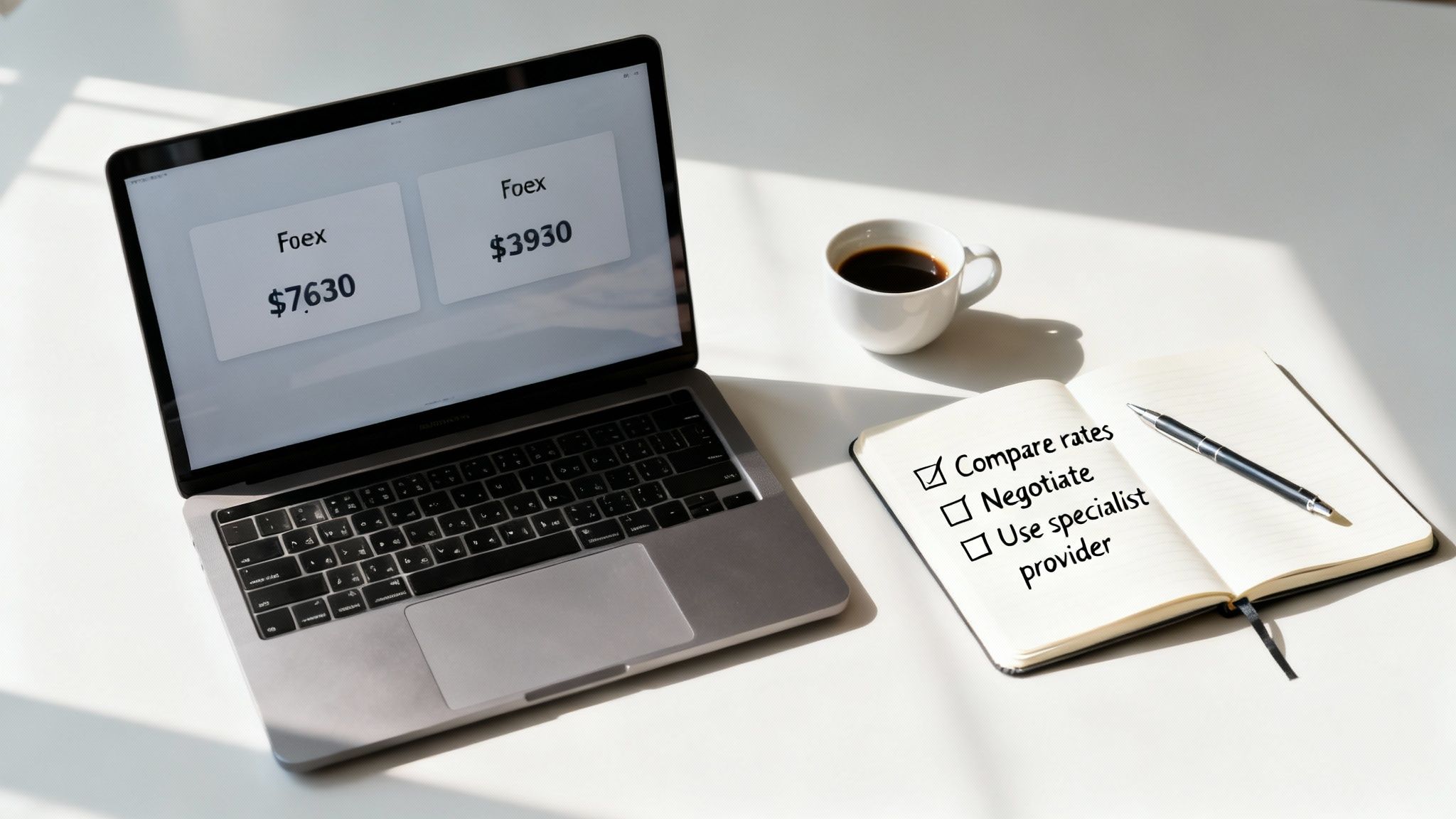
Knowing about the hidden costs in forex is one thing, but actually turning that knowledge into real savings is where it counts. Securing a better USD buying rate isn't about perfectly timing the market or just getting lucky. It’s about having a clear, repeatable process that puts you back in the driver's seat.
Your most powerful tool is information. Before you even think about accepting a rate, you need a benchmark. A quick check of the live mid-market rate on a trusted source like Reuters gives you the true value of your dollars at that exact moment. This simple step shifts you from being a passive rate-taker to an informed business owner who can spot an unfair markup from a mile away.
Once you have that benchmark, you can confidently evaluate any quote you're given. This is the foundation for a much smarter way to handle your currency conversions.
Create Your Forex Strategy
Stop treating each forex conversion as a one-off chore. Instead, build a consistent strategy around it. This means actively comparing different providers, digging into their fee structures, and never being afraid to ask for a better deal. It’s your money, after all.
A simple, repeatable process will make sure you’re always getting the best possible value:
- Always Benchmark the Rate: Before every single conversion, look up the live mid-market USD/ZAR rate. This is your non-negotiable starting point.
- Question Your Provider: Get on the phone with your bank or forex service and ask them directly: "What is your spread on this transaction?" How they answer—or avoid answering—tells you everything you need to know about their transparency.
- Negotiate for Larger Volumes: If you’re dealing with large or frequent USD payments, you have leverage. Use it. Contact your provider and ask for a sharper rate based on your business volume. Many will offer preferential rates to keep a good client happy.
The best strategy of all? Move away from providers that profit from hidden spreads in the first place. When you partner with a service that offers the real mid-market rate, you cut out the need for negotiation and guesswork entirely.
Explore Specialist Forex Providers
Traditional banks often get away with wide spreads because they have huge overheads to cover. In contrast, modern fintech providers have built their entire businesses on transparency and efficiency, which almost always results in a more competitive USD buying rate.
Platforms like Zaro were created to solve this exact problem. By giving businesses access to the real, zero-spread exchange rate, they eliminate the hidden costs that quietly chip away at your profits. This direct-to-market access means you receive the full value of your hard-earned international income, turning a frustrating financial headache into a simple, predictable process that directly boosts your bottom line.
Got Questions About Forex Rates? Let's Clear Things Up.
Even after you get the hang of the USD buying rate, a few common questions tend to pop up. Let's tackle them head-on, so you can feel completely confident when dealing with your business's forex.
What’s the Real Difference Between the "Buying" and "Selling" Rate?
It all comes down to perspective: whose money is being bought?
Think of it this way: the buying rate (often called the 'bid' rate) is the price a bank or forex provider will pay to buy your hard-earned US dollars from you. This is the number that matters when you’re bringing your USD revenue home and converting it into Rand.
On the flip side, the selling rate (the 'ask' rate) is the price they charge you to buy US dollars from them. You’ll see this rate when you need to pay an international supplier or invoice in USD. The gap between these two rates is the spread, which is simply the provider's profit margin.
Why Doesn't My Bank’s Rate Match the One I See Online or on the News?
This is probably the most common source of frustration for business owners. The rate you see on Google, financial news sites, or your favourite currency app is almost always the mid-market rate.
Think of the mid-market rate as the wholesale price of a currency—the midpoint between what global banks are buying and selling it for. It's a fantastic benchmark for fairness, but it's not a rate that businesses or individuals actually get.
Your bank gives you a retail rate, which is the mid-market rate plus their own additions. This includes their profit margin (the spread), a bit extra to cover their own costs, and a buffer against sudden market swings.
Here's a simple way to see exactly what you're losing in the spread: (Mid-Market Rate - Your Buying Rate) x Amount in USD = Hidden Cost in ZAR
This quick calculation shows you, in plain Rands and cents, how much of your money is disappearing into the spread on every single transaction. It’s the first step toward finding a provider who offers a much fairer deal.
Stop losing money to hidden spreads. With Zaro, you get the real exchange rate with zero markups, ensuring you keep every Rand you earn. See how much you can save.