
Googling the "USD buying rate today" can be a frustrating exercise. You see one number online, but when you go to the bank, they offer you something completely different. It's a common headache, and it all comes down to a fundamental misunderstanding of how currency rates actually work. The rate you see on a search engine is almost always the mid-market rate—a wholesale price that's simply not available to individuals or businesses.
This guide will demystify why that gap exists and, more importantly, show you how your business can get much closer to that elusive "real" rate.
Why The Rate You See Isn't The Rate You Get

Ever checked the USD to ZAR exchange rate online, only to be offered a much less attractive one by your bank moments later? You're not alone. This happens to everyone, and it’s because the foreign exchange world operates with a few different types of rates.
Think of it like buying fruit from a supermarket. The store buys apples from the farmer at a wholesale price. They then mark up the price and sell those same apples to you, the customer, at a retail price. That markup covers their costs—like rent, staff, and transport—and includes their profit. Foreign currency is bought and sold in exactly the same way.
The Three Key Exchange Rates
To really grasp today's USD buying rate, you need to get familiar with three distinct rates that financial institutions juggle every day:
The Mid-Market Rate: This is the "wholesale" price of a currency. It’s the perfect midpoint between what buyers are willing to pay and what sellers are asking for on the massive global markets. You'll see this rate on Google or financial news sites, and it's the truest snapshot of a currency's value. The catch? It's not available to the public for actual transactions.
The Buying Rate: This is the rate a bank or forex provider will offer to buy US Dollars from you in exchange for South African Rand. This rate is always lower than the mid-market rate. It's the "retail" price they are prepared to pay you.
The Selling Rate: This is the rate at which they will sell US Dollars to you. Unsurprisingly, this rate is always higher than the mid-market rate.
Understanding The Spread
The gap between the buying rate and the selling rate is called the spread. This is how banks and traditional forex providers make their money—it’s their profit margin baked right into the rate. The wider the spread, the more they make, and the worse the deal is for you.
A wide spread is a hidden cost that quietly eats into your profits on every single international transaction. Even a seemingly small difference of a few cents per dollar can add up to thousands of Rands in lost revenue over time.
This is precisely why the rate you get is never the rate you see. Financial institutions take the mid-market rate and add their margin to create their own buying and selling prices. For any South African business involved in international trade, whether you're importing goods or receiving payments from overseas clients, that spread is a major operational cost.
The key is to find a provider that keeps this spread as narrow as possible, getting you a buying rate that’s much closer to the real mid-market rate and putting more money back into your business.
What Really Moves The USD To ZAR Exchange Rate
The daily value of the Rand against the US Dollar isn't a lottery; it’s a direct reflection of powerful economic forces constantly at play, both here at home and across the globe. To get a real sense of why the USD buying rate today is what it is, you have to look at the economic stories unfolding behind the numbers.
Think of the ZAR and the USD in a constant tug-of-war. In one corner, you have the South African Reserve Bank (SARB), and in the other, the US Federal Reserve (the Fed). Their main tool for pulling the rope is interest rates.
When the Fed hikes its interest rates, holding US Dollars suddenly becomes more attractive for global investors. Why? Because they can earn higher returns on their cash. This spike in demand strengthens the Dollar, which often means the Rand loses a bit of ground. On the flip side, if the SARB decides to increase our rates, it can make the Rand more appealing and pull the exchange rate back in South Africa’s favour.
The Global Appetite For South African Goods
Another massive influence is South Africa’s position as a major exporter of commodities. The health of our economy is deeply connected to the global prices of resources like gold, platinum, and coal.
When international demand for these commodities is strong and prices are climbing, more US Dollars flow into South Africa to pay for them. It’s simple supply and demand—this influx of foreign currency naturally strengthens the Rand. But if global manufacturing slows down or commodity prices take a dive, the reverse happens, putting pressure on the ZAR.
The image below breaks down the main pillars that support the daily USD buying rate, from interest rates and inflation to major global events.
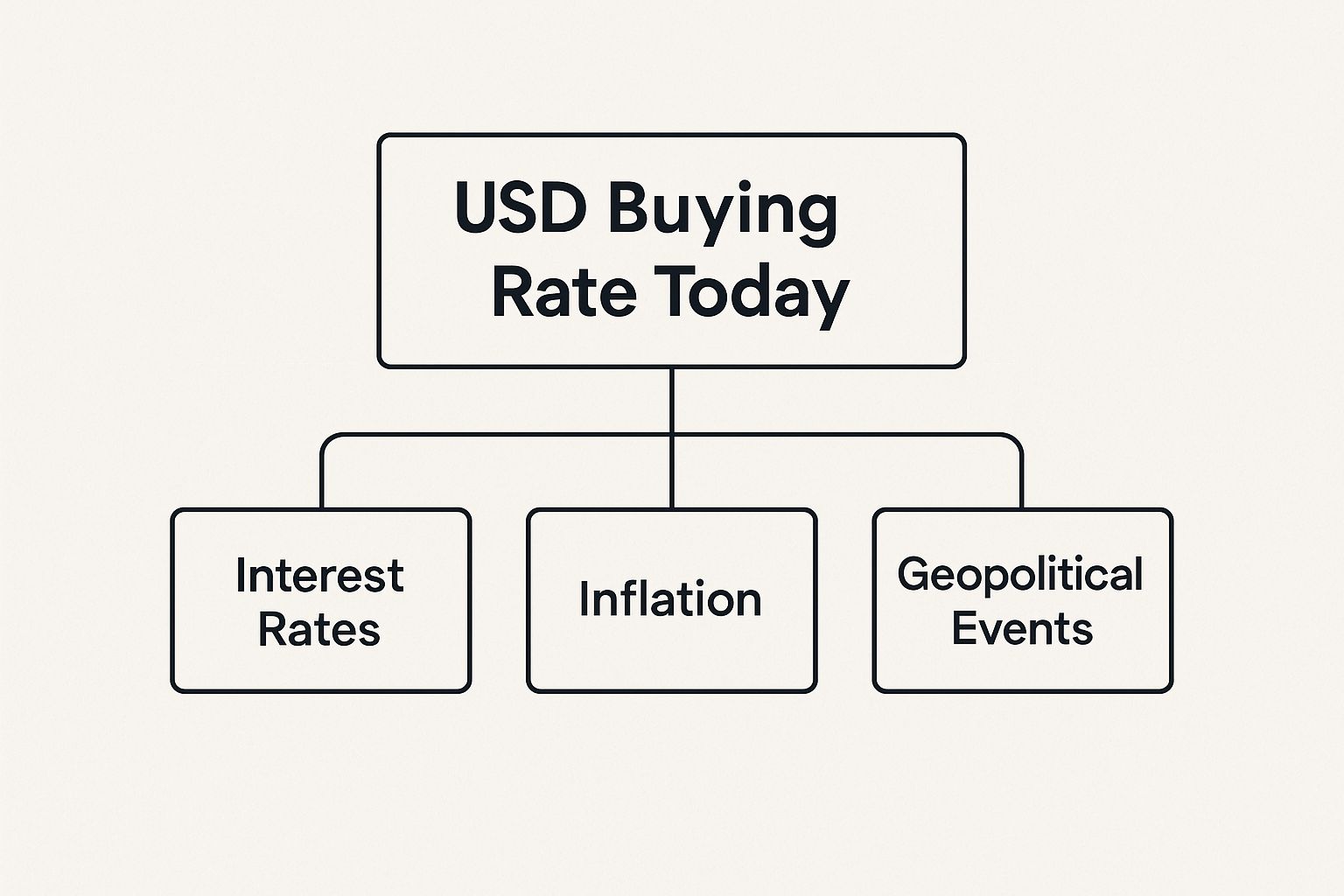
As you can see, broad economic policies and global happenings create a ripple effect that directly lands on the rate you get for your dollars.
Investor Confidence And Geopolitical Tides
Beyond the hard numbers, market sentiment—or what investors are feeling—plays a huge part. The Rand is often viewed as an "emerging market" currency, which makes it particularly sensitive to shifts in global investor confidence.
Political stability, clear economic policies, and social factors all shape how investors see South Africa. Good news can attract foreign investment and boost the ZAR, while uncertainty can cause capital to flee, weakening our currency.
This isn't just a South African story. Many regional economies see their currencies swing based on both local issues and the overall strength of the US Dollar. For example, a neighbouring country’s currency saw significant movement against the dollar over just six months. This shows how changes in trade, foreign investment, or local demand for the USD can cause dramatic shifts. You can find more insights into these regional currency trends at Exchange-Rates.org.
All these factors weave together, creating a constantly moving target. The table below summarises the key drivers you should know.
Key Factors Influencing the ZAR/USD Rate
This table offers a quick summary of the primary economic indicators that cause the ZAR/USD exchange rate to fluctuate, helping you grasp the core concepts at a glance.
| Influencing Factor | Impact on ZAR Strength (Simplified) | Real-World Example |
|---|---|---|
| Interest Rates | Higher SA rates can strengthen the ZAR. | The SARB raises the repo rate to combat inflation, attracting foreign investment. |
| Commodity Prices | Higher prices for gold/platinum strengthen the ZAR. | A global manufacturing boom increases demand for platinum, boosting the Rand. |
| Inflation | High SA inflation (vs. the US) weakens the ZAR. | If local prices rise faster than in the US, the Rand's buying power falls. |
| Economic Growth (GDP) | Strong GDP growth strengthens the ZAR. | News of better-than-expected economic growth attracts investors. |
| Political Stability | Uncertainty weakens the ZAR; stability strengthens it. | A national election or major policy shift can cause immediate currency volatility. |
Understanding these elements shows that the USD buying rate today is far more than just a number—it’s a snapshot of this complex interplay. It reflects the global market's current confidence in the economic futures of both the United States and South Africa, updated with every new piece of information.
How To Navigate Daily Forex Volatility
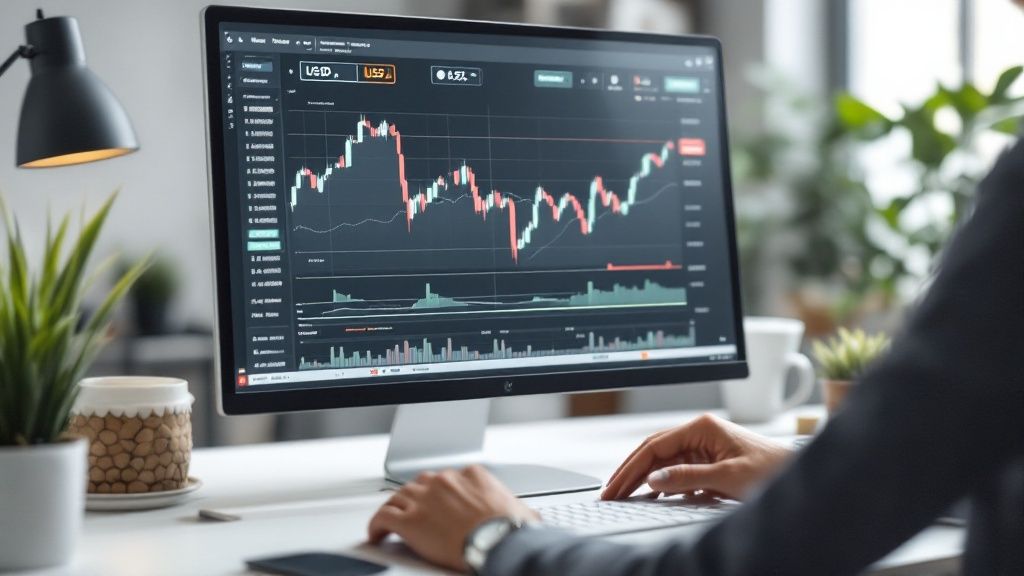
If long-term economic trends are the ocean's tide, think of daily news events as the unpredictable waves that rock your business transactions. These short-term swings, known as volatility, have a direct and immediate impact on the USD buying rate today, especially for companies making frequent international payments.
A single inflation report from the United States or an unexpected political announcement in South Africa can send ripples through the currency markets in an instant. These events often cause sharp, sudden movements that can change the value of your dollar-denominated invoices in a matter of hours.
For any business, the key is learning to tell the difference between routine ‘market noise’ and a genuine shift in the currency’s direction. Market noise is just the minor, everyday fluctuation that’s a normal part of foreign exchange. Reacting to every small dip or spike can easily lead to poor financial decisions.
Distinguishing Noise From Trends
Developing a strategy to handle this daily volatility is crucial for protecting your profit margins. Instead of reacting to headlines with knee-jerk currency exchanges, a more disciplined approach is what’s needed.
Avoid Emotional Decisions: News headlines are designed to grab attention, but they often lack the context you need for a sound financial strategy. A dramatic headline about a market shift might only reflect a temporary blip.
Focus on Consistency: Trying to perfectly "time the market" to catch the absolute best rate of the day is a stressful and often fruitless game. The real savings come from consistently getting a better rate over the long haul.
This is where a stable, transparent forex partner becomes invaluable. A reliable partner provides rates close to the mid-market standard, shielding your business from the wide spreads and hidden fees that only amplify the impact of daily volatility.
The Real-World Impact Of Short-Term Swings
Even during what might seem like a stable period, currency pairs can fluctuate enough to seriously affect your bottom line. Short-term volatility is a constant factor that businesses simply have to account for in their financial planning.
The core challenge isn't predicting every wave in the market, but rather having a sturdy ship that can navigate them. For businesses, that ship is a dependable forex strategy built on transparency and low costs, not on risky market timing.
For instance, looking at short-term data shows just how much a rate can move within a week. If we examine the USD to ZMW exchange rate, back in September 2025, the rate moved between approximately 23.44 and 24.10 in a single week—a fluctuation of roughly 2.7%. This highlights how sensitive regional currency markets can be to both local and global factors. You can explore more historical currency data and its implications on Wise.com.
Ultimately, navigating daily volatility is less about becoming a forex trader and more about adopting a smarter, more consistent approach. By partnering with a service that offers consistently favourable rates, you remove the guesswork and protect your business from the daily turbulence of global currency markets.
How South African Businesses Can Secure Better Rates
It’s one thing to know that high fees and unpredictable rates are eating into your profits, but it’s another thing entirely to find a way around it. For South African businesses, getting a better USD buying rate today means moving away from the old-school banking model that relies on confusing pricing to make its money.
The main offender here is the ‘spread’—the gap between the wholesale mid-market rate (the "real" rate) and the less favourable retail rate your bank gives you. Every single time you exchange currency, this spread quietly slices off a piece of your revenue. It might not seem like much on one transaction, but for any business dealing with international payments regularly, it adds up to a staggering amount.
Escaping The High Cost Of Traditional Forex
Let's put this into perspective. Say your business needs to convert $100,000 from an export sale. If the mid-market rate is R18.00 to the dollar, your money is worth R1,800,000. Simple enough.
But your bank might offer you a buying rate of R17.75 after tacking on their spread. That tiny difference of R0.25 per dollar means you only get R1,775,000. Just like that, the bank’s spread has cost your business a cool R25,000 on a single transaction. Over a financial year, these hidden costs become a massive, and often unnoticed, operational expense.
The traditional foreign exchange system is designed to build profit margins directly into the exchange rate. Businesses often pay these hidden costs without fully realising how much value they are losing.
This is exactly where modern financial technology platforms like Zaro come in. They are built to break this old model by giving you direct access to rates that are much, much closer to the true mid-market benchmark.
The Fintech Advantage: Transparency And Technology
Fintech solutions are built on a completely different premise. They use smart technology and have much leaner operations, allowing them to sidestep the expensive overheads and clunky, outdated systems that bog down traditional banks. This efficiency means better rates and lower fees for you.
For a South African business, this translates to real, tangible benefits:
- Access to Real Exchange Rates: Platforms like Zaro give you currency exchange at the real spot rate with zero spread. The rate you see is the rate you get—no padding for profit.
- No More Hidden Fees: Beyond the spread, international transfers are notorious for SWIFT fees and other hidden banking charges. Modern platforms get rid of these completely, giving you total clarity on costs.
- Faster, Smarter Transfers: Without the layers of bureaucracy found in old banking systems, your money moves much faster. This directly improves your cash flow and makes your business more agile.
This shift puts you, the business owner, back in control of your foreign exchange. You no longer have to just accept whatever rate you're offered. Instead, you can actively partner with a provider that has your financial interests at heart. For businesses serious about shielding themselves from currency swings, it's worth exploring Master Foreign Exchange Risk Management Strategies to better protect your bottom line.
By stepping away from institutions that profit from wide spreads, South African companies can unlock serious savings. Using a platform like Zaro transforms currency exchange from a costly headache into a smooth, predictable, and affordable part of doing business. It’s a strategic move that ensures more of your hard-earned money stays where it belongs—in your company.
Tools for Tracking the USD Buying Rate
Keeping a close eye on currency markets is no longer just for professional traders. For any South African business dealing in dollars, knowing how to track the USD buying rate today is a fundamental part of smart financial management. It’s not about obsessing over every dip and spike; it’s about knowing when to act.
The key to this is getting your hands on accurate, real-time data. Specifically, you need to find the mid-market rate. Think of this as the “true” exchange rate—the wholesale price that banks and large financial institutions trade currencies at, before they add their own markup.
Why does this matter? Because the mid-market rate is your benchmark. When you get a quote from a bank or forex provider, you can compare it against the mid-market rate to see exactly how much they're charging you through their "spread." This transparency is the first step to saving money.
Finding Reliable Rate Information
Finding this data is easier than you might think, as long as you know where to look. You’ll want sources that offer clean, unbiased information on the ZAR/USD pair.
A few reliable options include:
- Financial News Websites: Big names like Bloomberg and Reuters have live currency trackers that show the mid-market rate. They’re great for a quick, no-nonsense snapshot of the market.
- Independent Currency Converters: Many reputable online tools provide not just the live rate but also historical charts. This lets you zoom out and see how the rand has performed against the dollar over the last day, week, or even year.
- Fintech Platform Dashboards: Modern payment platforms, including Zaro, often build this transparency right into their system. You'll see the real-time spot rate directly on your dashboard before you even start a transaction.
The single most important shift you can make is to stop using your bank’s advertised rates as your guide. Those rates already have a profit margin baked in. Always start with the pure, unadulterated mid-market rate as your one source of truth.
Two Approaches to Forecasting
Once you’re comfortable tracking the live rate, you might wonder how experts try to anticipate where it’s headed next. This isn't about crystal ball predictions, but rather about understanding the logic behind market movements. There are two main schools of thought here.
The first is fundamental analysis. This is the big-picture approach. It involves looking at the overall economic health of both South Africa and the United States—things like interest rate changes, inflation data, and GDP growth. These are the core economic drivers we talked about earlier.
The second is technical analysis. This method is all about the charts. Technical analysts study historical price patterns and trading volumes, believing that past market behaviour can offer clues about future movements, often independent of the latest economic news.
For a business owner, a basic understanding of fundamental analysis is usually the most practical. Knowing how a major economic announcement is likely to affect the USD buying rate today gives you the context you need to make a smart call without getting bogged down in complex trading jargon.
This kind of volatility is normal. For example, as of 19 September 2025, the Zambian Kwacha had dropped 1.03% against the USD over the month but was up 9.52% for the year. By understanding the fundamentals, you can see the story behind the numbers. For more detail on these kinds of shifts, you can explore regional currency trends and economic forecasts on sites like TradingEconomics.com.
Got Questions About The USD Buying Rate? We've Got Answers
Stepping into the world of foreign exchange can feel a bit like learning a new language. But don't worry, the basics are more straightforward than you might think. Let's break down some of the most common questions South African businesses have about the USD buying rate today.
Getting these fundamentals right is the first step to making smarter financial moves for your business.
What’s The Difference Between A Buying Rate And A Selling Rate?
It's a simple but crucial distinction. The buying rate is what a forex provider (like your bank) will pay you in Rands for your US dollars. Think of it as the price they buy USD from you.
The selling rate, on the other hand, is the price you pay in Rands to purchase US dollars. It's what they sell USD to you for. You'll always notice the selling rate is higher than the buying rate. That gap between them is called the "spread," and it's where traditional providers make their profit.
For your business, the mission is clear: you want a buying rate that's as close to the real market rate as possible. It means more of your hard-earned money stays in your pocket.
Why Does The Rate On Google Look So Different From My Bank's Rate?
That rate you see when you Google "USD to ZAR" is what's known as the mid-market rate. Picture it as the true, wholesale price of a currency at any given moment—the perfect midpoint between what global buyers are offering and what sellers are asking for.
It's a fantastic benchmark for fairness, but here's the catch: it's not a rate that's actually offered to regular customers or businesses. Banks and forex services take that mid-market rate and add their margin (the spread) to create the buying and selling rates you see. That’s precisely why the USD buying rate today from your bank never looks as good as the one on Google.
This is where modern platforms like Zaro are changing the game. They're built to cut out the hefty spreads, offering you rates that hug the real mid-market rate much more closely.
How Often Does The USD Buying Rate Change?
Constantly. The USD/ZAR exchange rate is a living thing, fluctuating every single second that global forex markets are open. Think of it like a live broadcast, reacting instantly to breaking economic news, political shifts, and massive trades happening around the world.
What does this mean for your business? The quote you get now might be different in five minutes. Forex providers are always adjusting their rates throughout the day to keep up with these real-time market movements.
Is There A "Best Time" Of Day To Exchange Currency?
Honestly, trying to time the forex market to catch the perfect daily peak is a recipe for a headache. It's a high-stress game with very little reward. While it's true that market activity is highest when major trading hubs like Johannesburg, London, and New York overlap, chasing these tiny, fleeting windows isn't a practical business strategy.
A much smarter approach is to focus on what you can control. Instead of gambling on market timing, partner with a provider who gives you consistently tight spreads and total transparency on fees. This single move will save you far more money in the long run than trying to outsmart the daily wobbles of the market. It’s about building a reliable, cost-effective process, not getting lucky.
Stop letting hidden fees and poor exchange rates eat into your profits. With Zaro, your business gets the real spot exchange rate—with zero spread and no hidden costs. It’s time to take back control of your international payments and see the savings for yourself. Learn more and get started with Zaro today.