
The USD rand exchange rate forecast points towards a period of managed volatility. While bumps are always expected, the rand is showing some potential to claw back ground against a US dollar that seems to be losing a bit of its steam.
The main things to watch are the interest rate gap between the US and South Africa, the general mood of global investors (are they feeling risky or safe?), and of course, how our own local economy is holding up.
Decoding the USD/ZAR Exchange Rate
Before we get into predictions, let's pull back the curtain on what actually makes the USD/ZAR pair tick. Think of it like a see-saw, constantly tipping back and forth based on the economic health and appeal of both the United States and South Africa. Every little movement you see on the chart is a reaction to these powerful underlying forces.
At the end of the day, it all comes down to a simple question: are international investors more eager to buy South African rands, or do they prefer the safety and stability of the US dollar? It’s a global tug-of-war, where a decision made by the US Federal Reserve in Washington can have a direct knock-on effect on the price of groceries here in South Africa.
The Core Drivers of Value
The dance between the dollar and the rand isn't random; it's guided by some pretty clear economic principles. We're talking about a few key players here: interest rates, commodity prices, and political stability. Together, these factors shape how investors feel and, consequently, where they decide to put their money.
This infographic gives a great visual breakdown of the primary elements that steer any USD rand exchange rate forecast.
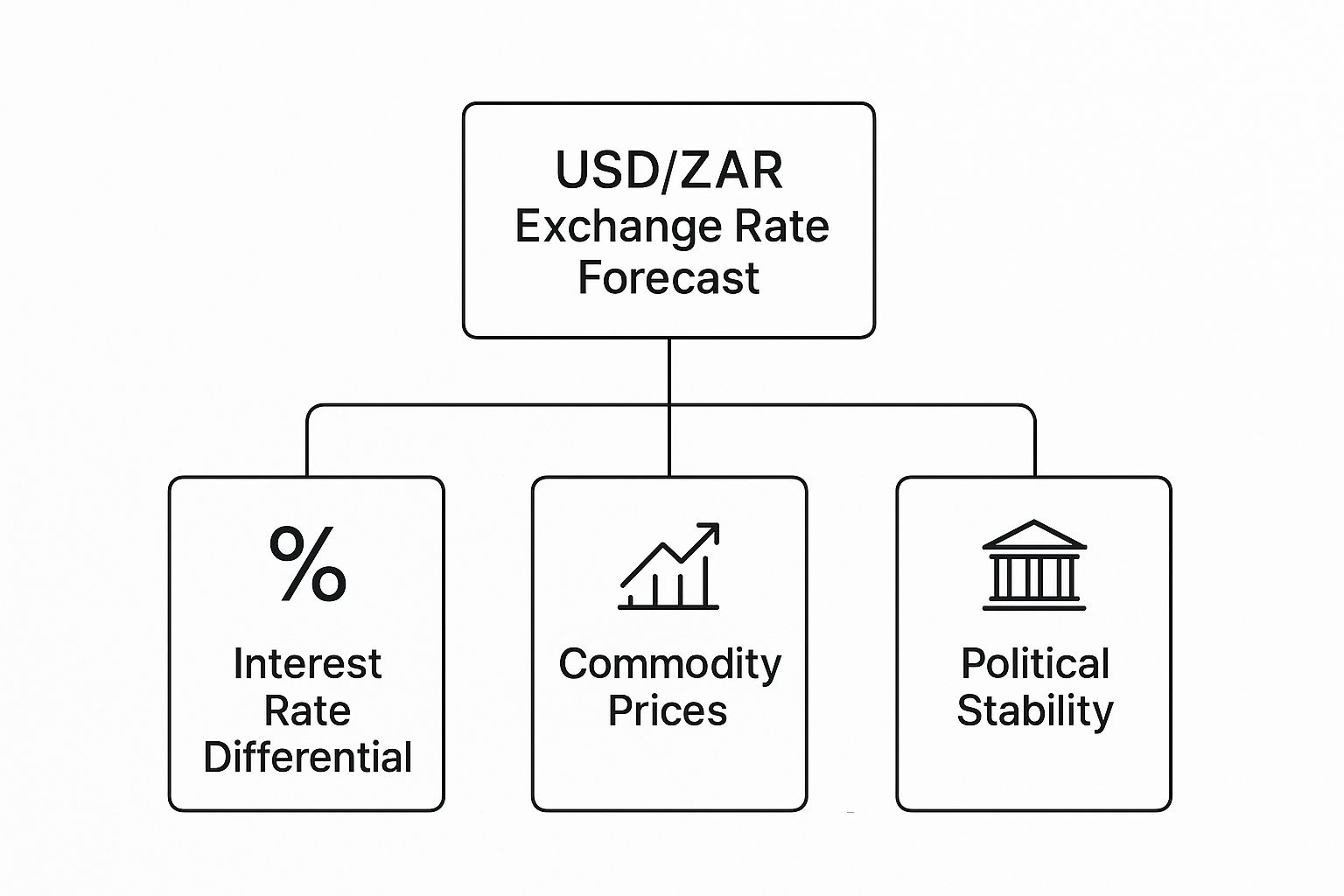
As you can see, things like interest rates, what's happening with commodities, and the political climate are the real pillars holding up a currency's value. A sudden wobble in one of these can send ripples through the entire system, triggering some serious market moves.
Primary Drivers of the USD/ZAR Exchange Rate
To truly get a handle on the rand's behaviour, it helps to see the main drivers laid out clearly. Each factor tells a piece of the story, influencing whether the rand strengthens or weakens.
| Economic Factor | Impact on Rand (ZAR) | Real-World Example |
|---|---|---|
| Interest Rate Differential | Higher SA rates relative to the US tend to strengthen the rand as they attract foreign investment seeking better returns. | The South African Reserve Bank (SARB) raises its repo rate to 7%, while the US Fed rate is at 5%. This wider gap makes holding rands more attractive. |
| Commodity Prices | As a major exporter of precious metals and minerals, higher commodity prices (like gold, platinum, and coal) typically strengthen the rand. | A global surge in gold prices due to economic uncertainty leads to increased export revenues for South Africa, boosting demand for the rand. |
| Global Risk Sentiment | During times of global uncertainty, investors flee to "safe-haven" currencies like the USD, causing the rand to weaken. | News of a major international conflict causes a "risk-off" mood, and investors sell emerging market currencies like the ZAR to buy US dollars. |
| Local Political Stability | Positive political developments and stable governance strengthen the rand by boosting investor confidence. | A smooth and decisive national election perceived as business-friendly can lead to a relief rally for the rand. |
| Economic Growth (GDP) | Stronger-than-expected GDP growth in South Africa usually strengthens the rand, signalling a healthy and attractive economy. | The release of data showing SA's economy grew by 2% when only 1% was expected can lead to immediate rand strengthening. |
These factors don't operate in a vacuum; they interact and often pull in different directions. That's what makes forecasting so challenging and why a deep understanding is crucial.
Understanding Historical Volatility
Let's be honest: the rand is known for being a bit of a rollercoaster. It often experiences big swings in short spaces of time. This isn't a flaw; it's just the nature of an emerging market currency that's highly tuned in to global economic shifts and investor moods.
For example, looking back, the rand hit a peak against the US dollar in April 2025, touching an all-time high of roughly 19.93 ZAR per USD. But it didn't stay there for long. The currency showed its trademark resilience, and by early September 2025, the USD/ZAR rate had pulled back to around 17.58. That’s a nearly 7% appreciation for the rand in just a few months. You can explore more historical currency data over at TradingEconomics.
Understanding these past swings gives us vital context. It proves that while the rand can take a serious knock from global or local pressures, it also has a proven ability to bounce back strongly when conditions turn favourable.
This dynamic character is precisely why a simple USD rand exchange rate forecast can never be set in stone. It has to be constantly checked and re-evaluated against the latest news on inflation, economic growth, and government policy in both countries. Getting a solid grip on these fundamentals is your first and most important step to making smarter financial decisions in a market that's always on the move.
How Global Headwinds Shape the Rand Forecast

The South African rand doesn't exist in a vacuum. It's deeply plugged into the pulse of the global economy, and international events often act like powerful ocean currents, pulling the currency in a certain direction regardless of what's happening at home. To make any kind of accurate USD rand exchange rate forecast, you first have to understand these external pressures.
Think of the global investment climate as having two basic settings: 'risk-on' and 'risk-off'. When investors are feeling confident and optimistic ('risk-on'), they're more adventurous, hunting for higher returns in emerging markets like South Africa. This flood of foreign capital increases demand for the rand and makes it stronger.
But when global uncertainty creeps in—maybe from geopolitical tensions or whispers of a recession—that switch flips to 'risk-off'. Investors get nervous. They pull their money from anything they see as risky and scramble for the perceived safety of the US dollar. This capital flight can weaken the rand, sometimes dramatically.
The Federal Reserve's Dominant Role
Sitting right at the heart of this global risk sentiment is the US Federal Reserve (the Fed), America's central bank. The Fed's decisions on interest rates create powerful ripples that travel across the globe, and the rand is particularly sensitive to them.
When the Fed hikes its interest rates, it suddenly becomes more attractive to hold US dollars because they offer a higher, safer return. This acts like a magnet for investment capital, pulling it towards the United States and away from other countries. The result? A stronger USD and a weaker rand.
The opposite is also true. If the Fed starts talking about cutting rates, the shine comes off the dollar a bit. Investors begin looking for better returns elsewhere, and that can send capital flowing back into emerging markets, giving currencies like the ZAR a boost. A look at the broader global interest rate outlook shows just how much pressure these central bank decisions can put on currencies like the rand.
A key takeaway: The Fed's policy often sets the mood music for the entire world. A "hawkish" Fed (ready to hike rates) usually means headwinds for the rand, while a "dovish" Fed (open to cutting rates) can provide a welcome tailwind.
The Influence of Global Economic Health
It's not just about the Fed, though. The general economic health of the world's major players has a huge impact. China, for instance, is one of South Africa’s biggest trading partners, so its economic performance is critical. A slowdown in Chinese factories means less demand for South African raw materials, which translates to lower export income and, you guessed it, a weaker rand.
Likewise, geopolitical shocks—from trade wars to conflicts—inject uncertainty into the market. This almost always triggers a 'risk-off' stampede into the US dollar. These external events can easily overwhelm positive local news, showing just how often the global stage calls the shots for the rand's day-to-day direction.
South Africa's Internal Economic Pressures

While what happens in the US or China certainly makes waves, the real story of the rand is often written right here at home. To get a handle on any USD rand exchange rate forecast, we have to look inwards at the unique pressures and opportunities shaping South Africa’s economy. These domestic issues can either pour fuel on a global trend or act as a crucial handbrake.
South Africa's economic engine is famously powered by commodities. As a world leader in exporting resources like platinum, gold, and coal, our fortunes are often tied to global prices. When those prices are booming, US dollars from export sales pour into the country and get converted to rand, pushing its value up.
Of course, that’s a double-edged sword. This reliance makes us vulnerable. A slump in global demand or a sudden drop in commodity prices can choke off those revenues in a heartbeat, putting immediate downward pressure on the ZAR. It’s why the rand often feels the sniffles when major industrial economies catch a cold.
Navigating Domestic Hurdles
Beyond the commodity rollercoaster, a few persistent local challenges constantly weigh on investor confidence—and by extension, the rand. Political uncertainty is a big one. Investors crave stability, so any hint of political turmoil often sends capital scurrying for safer shores, weakening our currency.
In the same vein, the country’s fiscal health is always under the microscope. Government debt, budget deficits, and how state-owned enterprises are managed are all report card items for global investors and credit rating agencies. A clear, sustainable plan to manage the nation’s finances inspires confidence, while worries about mounting debt can see the rand take a knock.
Then there's the elephant in the room: the energy crisis. Load shedding isn't just an inconvenience; it’s a direct drag on the economy. It disrupts everything from factory production to small business operations, stunting growth and souring the mood of anyone looking to invest here.
Key Insight: Local headlines about energy security and fiscal discipline aren't just for domestic consumption. They are critical data points that global markets use to price South Africa's risk, directly impacting the rand's value against the dollar.
The South African Reserve Bank's Role
Standing firm against these headwinds is the South African Reserve Bank (SARB). Its main job is to keep inflation in check, and its primary weapon is the interest rate. By hiking rates, the SARB can make rand-denominated investments more attractive to foreign capital, creating demand that helps prop up the currency.
It's a delicate balancing act. Jack up rates too high, and you risk choking off much-needed economic growth. Keep them too low, and you could let inflation run wild and watch the rand weaken. For this reason, the SARB's every move is a crucial piece of any credible USD rand exchange rate forecast. Sectors like tourism also offer a glimpse into the country's economic resilience, and you can find detailed research on South Africa's safari tourism market to better understand these drivers.
This complex mix of local factors creates a volatile trading environment. Looking back, you can see how the USD/ZAR pair swung wildly based on both global news and local policy announcements. It’s not uncommon to see the rand move from a high of around 17.8 ZAR per USD to a low near 17.36 ZAR in just a few months, with a six-month average often hovering around the 18 ZAR per USD mark. This daily and weekly volatility is a direct reflection of the constant tug-of-war between these powerful forces.
Short-Term USD Rand Forecast and Key Levels

When we zoom in on the immediate future—the next few weeks to a quarter—the USD/ZAR exchange rate becomes a story of fast-moving parts. This isn't about the long game; it's the tactical view that matters for anyone with near-term currency needs, like an importer paying a US dollar invoice or an individual needing to make an overseas transfer soon.
The big theme playing out right now is the shifting sentiment around the US dollar. After a long and dominant run, recent data suggests the US economy might finally be cooling off. This has put US Federal Reserve interest rate cuts on the table, a move that tends to make the dollar a little less appealing to global investors looking for the best returns.
Watching the Data Points
For the short-term outlook, it’s all about the next wave of economic data coming out of both South Africa and the US. You can think of these data releases as clues that professional traders use to anticipate what the central banks will do next.
Here are the key reports to keep an eye on:
- Inflation Figures (CPI): If South African inflation comes in hotter than expected, it could pressure the SARB to keep interest rates high, which would be a positive for the rand.
- Employment Data: On the flip side, weak US job numbers would add weight to the argument for a Fed rate cut, piling more pressure onto the dollar.
- Central Bank Commentary: Pay close attention to any speeches or statements from the Fed or SARB. The market hangs on every word, and a slight change in tone can trigger immediate swings.
It's this constant drip of new information that fuels the short-term volatility we so often see in the USD/ZAR pair.
A Trader's Perspective: "In the short term, currency markets run on surprises. It’s not the predictable announcements that move the needle; it’s the data point that comes in way off-consensus. That’s what has the real power to shift the exchange rate."
Key Technical Levels to Monitor
Beyond the economic fundamentals, traders live and breathe technical analysis to pinpoint important price levels. These levels act like psychological floors (support) and ceilings (resistance) that can often dictate the currency pair’s next move.
A support level is simply a price where buying interest has historically been strong enough to stop the rate from falling further. For the USD/ZAR, a decisive break below a key support level could signal a new period of rand strength is underway.
On the other hand, a resistance level is a price where selling pressure usually kicks in, putting a lid on any further gains. If the pair repeatedly fails to push above a certain resistance level, it’s a good sign that the dollar's upward momentum is running out of steam. Keeping an eye on these levels gives us a practical map for potential price movements in the immediate USD rand exchange rate forecast.
Long-Term Projections for the Exchange Rate
When we step back from the daily market chatter and look at the bigger picture, the long-term USD rand exchange rate forecast—thinking 6 to 18 months ahead—is all about the deeper, more fundamental currents. This isn't about quick reactions; it’s about the major structural shifts that will truly guide the rand's journey.
For South Africa, the long-range outlook really comes down to a few critical factors right here at home. Progress on key economic reforms, especially those that can attract foreign direct investment and make it simpler to do business, is going to be the main engine. Long-term investors are looking for solid proof that the country is getting to grips with its core challenges.
The Impact of Structural Reforms
The energy sector is front and centre. Finding a reliable, lasting solution to load shedding would be a massive turning point, unlocking huge economic potential and dramatically boosting investor confidence. Any real headway on this front would likely give the rand a sustained boost, making it a much more appealing currency for the long haul.
At the same time, the government's fiscal policy is being watched like a hawk. A genuine commitment to cutting debt and running state-owned enterprises more effectively would signal stability and sound governance. Over time, this would strengthen the rand’s fundamental value against the US dollar.
The Big Picture: Over the long term, a currency is a reflection of its economy's fundamental health. If South Africa can successfully reform, grow, and stabilise, the rand will naturally strengthen, regardless of short-term global mood swings.
Global Commodity Cycles and US Policy
Looking beyond our borders, two major global forces will shape the rand’s path. The first is the cycle of commodity prices. As a major exporter of resources, South Africa thrives when there's a sustained bull market in precious and industrial metals. Simply put, strong global demand for our exports means a stronger currency.
The second, and arguably more powerful, influence is the long-term policy of the US Federal Reserve. If the US embarks on a lengthy cycle of interest rate cuts, the dollar becomes less attractive to hold. This tends to create a positive climate for emerging market currencies like the rand, as international capital starts hunting for better returns elsewhere. We saw this play out between March and August 2025, when a weaker US dollar helped push the USD/ZAR rate down by over 5%, from a high of 19.742 ZAR to a low near 17.449 ZAR. You can dig into more historical data by exploring the USD/ZAR's performance on Exchange-Rates.org.
Bringing it all together, most long-term forecasts suggest the rand will gradually strengthen or at least stabilise from its recent volatile levels. This, however, depends heavily on both positive local reforms and a favourable global backdrop. For any business planning major capital projects or an individual managing foreign assets, this long-range USD rand exchange rate forecast highlights just how crucial it is to keep a close eye on South Africa’s structural progress.
Taking Control: How to Manage Your Rand Exposure
Knowing where the rand might be heading is one piece of the puzzle. The real challenge is turning that USD rand exchange rate forecast into a solid plan to protect your money. Whether you're running a business or managing your personal finances, you can't just cross your fingers and hope for the best. You need to be proactive.
For businesses, one of the most powerful tools in the arsenal is the Forward Exchange Contract, or FEC. It's a bit like locking in a price for fuel before a long road trip. You agree on an exchange rate today for a payment you need to make or receive in the future, effectively taking all the guesswork out of the equation.
Hedging: Your Business's Financial Shock Absorber
Let's walk through a real-world example. Say your South African business has to pay a US supplier $100,000 in three months. Right now, the rate is a tidy R18.00 to the dollar, but the forecast looks a bit shaky, and you're worried the rand might take a dive.
This is where an FEC comes in. You can lock in that R18.00 rate today.
- Scenario A: The rand weakens to R19.00/$. Without the FEC, your bill would have ballooned by R100,000. But you're covered. You still pay the R1,800,000 you budgeted for, protecting your profit.
- Scenario B: The rand strengthens to R17.50/$. Yes, you'll miss out on the better rate and still pay the agreed R1,800,000. But that's the point of hedging – you traded a potential gain for absolute certainty, ensuring your profit margin wasn't wiped out by a bad day on the markets.
For any company trading internationally, this level of certainty is gold. It turns currency volatility from a dangerous unknown into a predictable line item on your budget, which makes financial planning infinitely easier.
Navigating currency risk involves choosing the right tool for the job. Different strategies offer varying levels of protection and flexibility, and what works for a large corporation might not be suitable for an individual.
Comparing Common Currency Risk Management Tools
| Strategy | Best For | Key Benefit | Consideration |
|---|---|---|---|
| Forward Exchange Contract (FEC) | Businesses with confirmed future international payments or receipts. | Locks in a specific exchange rate, providing 100% certainty on costs. | You miss out on potential gains if the market moves in your favour. |
| Currency Option | Businesses wanting protection from downside risk while keeping upside potential. | Provides the right, but not the obligation, to exchange currency at a set rate. | Requires paying an upfront premium, which is a non-refundable cost. |
| Spot Transfers | Individuals or businesses with immediate, small-value transfer needs. | Simple, fast, and reflects the current market rate at the moment of the transaction. | Offers zero protection against currency volatility; you get whatever the rate is. |
| Rate Alerts & Limit Orders | Individuals and SMEs waiting for a specific target rate for a non-urgent transfer. | Automates the process of securing a desired rate without constant market-watching. | The target rate may never be reached, potentially delaying the transaction indefinitely. |
Ultimately, the goal of these tools isn't to beat the market but to shield your finances from its unpredictability.
Smart Moves for Your Personal Finances
Individuals can play it smart, too. For big-ticket items like paying for a degree overseas or buying property abroad, timing is crucial. If the forecast suggests the rand is likely to gain some ground, holding off on your transfer for a few weeks could save you thousands. On the flip side, if the outlook is grim, moving your money sooner rather than later could be the wiser choice.
And a final word of advice: always look beyond your bank. Traditional banks are notorious for baking hefty, often hidden, markups into their exchange rates. It pays to shop around. A transparent service like Zaro can give you access to the real mid-market rate, making sure you keep more of your hard-earned money. Combine a good forecast with the right tools, and you’ll be ready to handle whatever the currency markets throw at you.
Frequently Asked Questions
Trying to get a handle on the forces pushing and pulling the USD/ZAR exchange rate can feel like a puzzle. Let's break down some of the most common questions to give you a clearer picture.
What Is the Biggest Factor Affecting the USD to Rand Exchange Rate?
If you had to pick just one, it would be the mood of global investors—what we call risk sentiment. And more often than not, the US Federal Reserve is the one setting that mood.
Think of it this way: when the Fed hikes interest rates, it's like turning up the gravity on the US dollar. Money gets pulled out of markets like South Africa and flows back to the perceived safety of the US, which weakens the rand. But when the Fed eases up, investors feel more adventurous and chase higher returns elsewhere, sending capital our way and giving the rand a boost.
How Do Commodity Prices Influence the Rand Forecast?
South Africa's economy is deeply connected to the earth. We're a major exporter of commodities like gold and platinum, which are priced in US dollars. So, when the global prices for these resources climb, more dollars flow into the country from our export sales.
All those extra dollars needing to be converted into rands increases demand for our local currency, helping it to strengthen. That's why a bullish forecast for commodity prices often points to a stronger rand down the line.
It's a classic double-edged sword, though. A weaker rand makes our exports cheaper for the rest of the world, which is great for miners and farmers. On the flip side, it makes crucial imports like oil and machinery more expensive, fuelling inflation that hits every consumer's wallet.
A strong rand keeps a lid on inflation but can make our export-heavy industries less competitive. At the end of the day, what the South African economy really craves is stability—an exchange rate that's predictable, not a rollercoaster.
Tired of getting stung by unpredictable bank markups on your international payments? Zaro gives your business the real exchange rate with zero hidden fees. See how much you can save on your next global transfer.