
When we talk about the live USD/ZAR rate, we're referring to the real-time, second-by-second value of the US dollar against the South African rand. It’s a number that reflects the absolute latest market conditions.
For any South African business exporting goods or services, this isn't just a figure you glance at on a news channel. It's a living, breathing factor that directly shapes the profitability of every single international deal you make. Keeping a close eye on this live data is absolutely crucial for making sharp, timely financial decisions.
Why the Live Rate Is Your Most Important Business Tool
Let's paint a picture. You've just landed a big contract with a client in the US. The profit margin looks fantastic on paper. But in the days it takes for the payment to clear and hit your account, a seemingly small shift in the USD/ZAR live rate has quietly shaved a significant chunk off your bottom line.
This isn't a rare occurrence; it's a daily reality for South African exporters and it highlights a fundamental truth: the live exchange rate is a constantly moving target. It’s influenced by dozens of global and local events every single minute. Relying on a once-a-day "closing rate" is like trying to navigate rush-hour traffic using a map you printed out yesterday morning—it’s just dangerously out of date.
The Problem with Static Daily Rates
A static or "daily" rate is just a snapshot from a single moment, often the close of business from the previous day. Using this old number for your planning can be seriously misleading.
- Delayed Information: The rate you're looking at could be hours old, completely missing the impact of overnight market news or new economic data.
- Inaccurate Costing: If you price your goods based on an outdated rate, you could easily undercharge. That difference comes directly out of your profits when you eventually convert the payment back to Rand.
- Missed Opportunities: On the flip side, a sudden favourable dip in the live rate might be the perfect moment to bring your dollar earnings home. You’d miss that window completely if you weren't watching in real-time.
Live Rates Fuel Smarter Decisions
Think of the usd zar live rate as your business’s financial speedometer. It gives you the immediate feedback you need to decide when to accelerate, when to hold back, or when to adjust your strategy. Accessing this real-time data turns it from a simple financial metric into a powerful business intelligence tool.
For an exporter, the difference between a rate of 18.20 and 18.25 on a $100,000 invoice is R5,000. This isn't just pocket change; that's the cost of a shipping container, a team bonus, or a new marketing push.
This moment-to-moment insight allows you to price your products with true confidence, knowing your quotes accurately reflect the current value of the dollars you’ll be earning. It gives you the power to choose the most strategic moment to convert your revenue, maximising the Rand that lands in your bank account.
Ultimately, this isn't just about watching numbers flicker on a screen. It's about actively protecting your hard-earned profits and building a more resilient, competitive international business.
What Really Moves the Rand-Dollar Rate?
Picture the USD/ZAR live rate as a constant tug-of-war. On one side, you have the US Dollar, and on the other, the South African Rand. A whole host of powerful global and local economic forces are constantly pulling on either side of the rope, creating the daily fluctuations that can make or break an exporter's bottom line.
These shifts aren't just random noise. They're direct reactions to economic news and data releases. For any exporter, figuring out what to watch for in the news can change the game, turning you from a passive price-taker into someone who can anticipate market swings and protect your profits. You don't need an economics degree—just a clear idea of who's pulling the rope.
The Big Two: Central Banks
The two heavyweights in this tug-of-war are undoubtedly the central banks: the South African Reserve Bank (SARB) and the United States Federal Reserve (the Fed). Their decisions on interest rates are probably the single biggest driver of currency strength.
Think of it like this: when the SARB raises its interest rates, holding Rands suddenly becomes more appealing for foreign investors looking for a better return on their money. This surge in demand for the Rand often strengthens its value against the Dollar. Of course, the opposite is also true. When the Fed hikes US interest rates, global capital tends to flock to the Dollar, which can weaken the Rand.
For any exporter, the key takeaway is simple: higher interest rates in South Africa can pull in a lot of foreign capital, which often leads to a stronger ZAR. This means each Dollar you earn from your exports will convert into fewer Rands when you bring it home.
Inflation and Economic Health
Another crucial piece of the puzzle is inflation. It’s essentially the rate at which prices are rising and, in turn, how fast your money is losing its purchasing power. Both South Africa and the US release regular inflation reports, like the Consumer Price Index (CPI), and currency traders watch these numbers like hawks.
If inflation in South Africa is running high, it can eat away at the Rand's value, making it weaker. On the flip side, if US inflation is high, it might signal that the Fed is about to raise interest rates to cool things down, which could give the Dollar a boost. It’s all a delicate dance of expectations and reactions.
This infographic really brings home how tracking live rates, instead of relying on outdated ones, has a direct impact on your business's profitability.

As you can see, sticking to a static rate creates a blind spot. Engaging with the live, real-time rate, however, empowers you to make smarter decisions and secure much better financial outcomes.
Commodity Prices and the Political Climate
You can’t talk about the Rand without talking about commodities. South Africa is a powerhouse exporter of resources like gold, platinum, and coal, and the global prices for these materials have a direct and powerful effect on the currency.
- When commodity prices are strong: High prices on the international market mean more foreign currency (mostly US Dollars) is flowing into South Africa to buy these goods. This increased demand for the ZAR naturally helps to strengthen it.
- When commodity prices are weak: A slump in commodity prices means less foreign money coming in, which puts downward pressure on the Rand. It’s a straightforward supply and demand situation.
Finally, there's the unavoidable factor of political stability. Any whiff of uncertainty—whether it's from upcoming elections, sudden policy changes, or social unrest—can make foreign investors incredibly nervous. This "risk-off" sentiment often leads them to pull their capital out of the country, weakening the Rand. In contrast, a stable and predictable political environment builds the confidence needed to support a stronger currency.
The Rand's day-to-day performance is a direct reflection of all these forces combined. For example, the South African Rand showed some impressive resilience over the past year. As of October 2025, it had strengthened by about 2.28% over the previous 12 months, which helps lower the cost of imports. Yet, the daily volatility is always there. The USD/ZAR rate hit 17.3964 on October 22, 2025, before pulling back to 17.3841 later that same day—a perfect snapshot of the constant flux in currency markets. You can dive deeper into the Rand's recent performance over on Trading Economics.
How to Effectively Track the Live USD ZAR Rate
Knowing what moves the market is one thing, but actively tracking it is how you get a real competitive edge. For an exporter, keeping an eye on the USD/ZAR live rate isn't a passive hobby—it's about having the right information to make profitable decisions at precisely the right moment. Thankfully, you've got several great options, and each one brings something different to the table.
Putting theory into practice means picking a tracking method that actually fits your business. You need data that’s not just accurate, but delivered in a way that helps you act fast. Some tools are built for high-level market analysis, while others are designed for one simple thing: locking in a rate and making a payment.
Your Options for Real-Time Rate Monitoring
The financial world is full of platforms designed to keep you in the loop. Let’s break down the most common types.
Major Financial News Platforms: Giants like Bloomberg and Reuters are the gold standard for financial data. They offer incredibly detailed charts and expert analysis, with information that’s updated by the second. The downside? Their platforms can be complex and are often built for full-time traders, not business owners who just need to get a payment sorted.
Specialised Forex Apps: There are countless mobile apps dedicated to tracking currency markets. Most are quite user-friendly, offering customisable charts and rate alerts sent straight to your phone. These are fantastic for keeping a pulse on the market while you're on the go or for setting reminders to check in when a certain rate is hit.
Business Payment Platforms: This is where a solution like Zaro really shines. These platforms don't just show you the rate; they build it right into your financial workflow. You see the live rate you can actually book, closing the gap between seeing the number and acting on it.
To help you decide, here’s a quick comparison of the different ways you can track the live USD/ZAR rate.
Comparison of USD ZAR Live Rate Tracking Tools
A comparison of different platforms for tracking live currency rates, highlighting their key features for business users.
| Tool Type | Update Frequency | Best For | Potential Cost |
|---|---|---|---|
| Financial News Sites | Real-time (seconds) | In-depth market analysis, professional trading | High subscription fees |
| Forex Mobile Apps | Real-time (seconds to minutes) | On-the-go monitoring, personal rate alerts | Free to moderate subscription fees |
| Business Payment Platforms | Real-time (seconds) | Executing transactions, managing cash flow | Low or no subscription, costs are in fees/spread |
| Bank Portals | Delayed or real-time | Making payments through a traditional bank | Bank account fees, higher spreads |
Each tool has its place, but for an exporter, the most practical solution is often the one that combines live data with the ability to transact immediately.
Understanding the Rate You Actually Get
Here's something every exporter needs to understand: the difference between the interbank rate and the customer rate. The rate you see on Google or a news site is usually the interbank rate—it’s the wholesale price banks use to trade currencies among themselves. It's the market in its purest form, but it’s not the rate you'll ever get.
When you make a payment through a bank or most providers, they add a spread, or margin, on top of that interbank rate. This is how they make their profit. On top of that, they might charge fixed transaction fees, like SWIFT fees, which eat even further into your total.
The real cost of your international payment is a combination of the exchange rate spread and any fixed fees. A seemingly small 1% spread on a $100,000 transfer costs you R18,000 if the rate is 18.00—a significant hidden expense.
This is exactly why transparency is non-negotiable. A platform that gives you the real exchange rate with a clear, low fee structure lets you forecast your costs accurately and get the most rand value from all your hard work.
Practical Tips for Effective Tracking
Just staring at the numbers as they flicker up and down isn't a strategy. To track the USD/ZAR live rate effectively, you need to be proactive.
Set Rate Alerts: Figure out your ideal target rate and your "worst-case" rate. Use a forex app or your payment platform to set up automatic alerts for when the market hits these levels. This stops you from having to check constantly and makes sure you don’t miss your window.
Choose the Right Tool for the Job: Your choice of tool should match your goal. If you're doing a deep dive into market trends, a platform like Bloomberg is brilliant. But if your goal is to execute payments and manage cash flow, an integrated solution like Zaro gives you the most direct and useful information.
Look Beyond the Rate: Always, always factor in the total cost. When you're comparing providers, ask them directly about their spreads, transaction fees, and any other hidden charges. You need to know the true "customer rate" to protect your profitability on every single deal.
How Rate Volatility Actually Hits Your Bottom Line
That live USD/ZAR rate you see flickering on the screen isn't just an abstract number. It's a powerful force that can completely change your company's financial picture overnight. For South African exporters, this isn't a theoretical risk—it's a day-to-day reality that directly impacts revenue, cash flow, and ultimately, your profitability.
Let's move past the jargon and look at what this really means for a business on the ground. The difference between a great month and a terrible one can be written in the tiny movements of that exchange rate.
When a Stronger Rand Puts the Squeeze on Profits
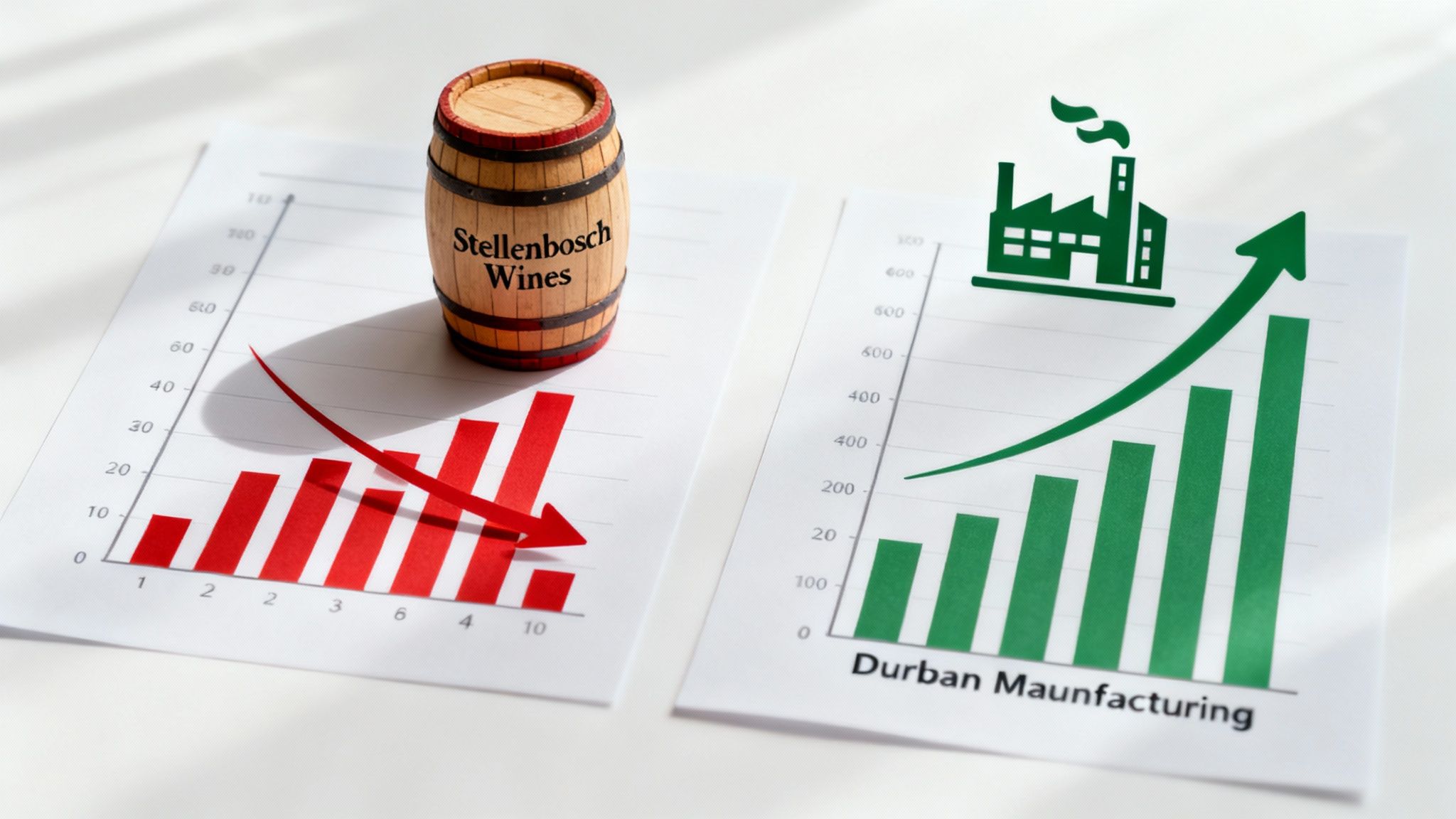
Picture a wine exporter, let's call them 'Stellenbosch Wines'. They land a fantastic order to a US distributor and invoice for $100,000. On the day they sign the deal, the exchange rate is a healthy 18.50 ZAR to the dollar.
They do the maths and forecast a revenue of R1,850,000. That figure comfortably covers all their costs and leaves them with a solid profit. The problem? Their client has 30 days to pay.
During that month, some positive economic news hits South Africa, and the Rand strengthens. By the time the distributor's payment finally lands, the live rate has dropped to 17.90 ZAR. When Stellenbosch Wines converts their $100,000, it's no longer R1.85 million. It’s now only R1,790,000.
In just 30 days, an unpredictable currency shift has wiped R60,000 off their top line. That’s not just a number on a spreadsheet—that's the cost of new oak barrels, a key staff member's monthly salary, or a marketing campaign they can no longer afford.
This is the real risk of currency volatility. Without a plan, your hard-earned profits are left completely at the mercy of market forces you can't control. The danger only gets bigger with larger deals and longer payment cycles.
How a Weaker Rand Can Be an Unexpected Bonus
Now, let's flip the script and look at 'Durban Manufacturing', a company that ships specialised parts to the US. They agree on a sale for $150,000 when the exchange rate is sitting at 17.80 ZAR, giving them an expected income of R2,670,000.
In the weeks that follow, global market sentiment shifts, and investors start favouring the US dollar. This causes the Rand to weaken. When Durban Manufacturing receives their payment, the USD/ZAR live rate has climbed to 18.60 ZAR.
Their $150,000 payment now converts to a much healthier R2,790,000.
That single currency swing handed them an unexpected windfall of R120,000. This is great news, of course. That extra cash can be put to good use upgrading machinery or rewarding the team. But while the outcome is positive, the lack of predictability is still a huge business challenge. Relying on luck is no way to run a company. For many businesses, managing cash flow through these fluctuations might even involve looking into tools like invoice factoring in South Africa.
Volatility is clearly a double-edged sword. Just look at recent history: the USD/ZAR rate hit a high of 18.785 ZAR on April 24, 2025, only to fall by around -7.35% over the next six months to a low of 17.150 ZAR by October 8, 2025. It’s a constant see-saw.
Shielding Your Business from the Uncertainty
So, how do you protect your business from these nasty surprises while still leaving the door open to benefit from good timing? The answer is hedging.
Put simply, hedging is just a strategy to reduce your financial risk. One of the most common and effective tools for an exporter is a Forward Exchange Contract, or FEC.
An FEC lets you lock in an exchange rate for a transaction that will happen in the future. It’s pretty straightforward:
- Agree on a Rate: You and your financial provider agree on a specific exchange rate for a set amount of currency on a future date.
- Lock it In: That rate is now set in stone, no matter what the live market does between now and then.
- Gain Certainty: When your payment date rolls around, you exchange the funds at the rate you agreed upon months earlier.
If Stellenbosch Wines had used an FEC, they could have locked in the 18.50 rate and guaranteed their R1,850,000 revenue. Their profit margin would have been completely safe. It’s all about bringing certainty back into your financial planning, turning exporting from a gamble into a predictable business process.
Bringing It All Together with Zaro
We've talked about the headaches of currency swings and the near-impossible task of pinning down the true USD ZAR live rate. Manually crunching numbers, wrestling with hidden bank fees, and constantly worrying about market shifts adds a huge administrative weight to your business. This is exactly why a specialised platform is no longer a nice-to-have; it's essential for acting on the rates, not just watching them.
Zaro was built from the ground up to tackle these very problems for South African exporters. We go way beyond simple rate-tracking by plugging live exchange rates directly into your invoicing and payment workflow. The whole idea is to get rid of the guesswork and manual slog, turning your international payments into a clear, manageable part of your business.
Instead of just giving you a number to look at, Zaro lets you create a USD invoice that instantly uses the real, current market rate. This simple step means your pricing is always spot-on, protecting your profit margins from the moment you send the invoice.
From Seeing the Rate to Using the Rate
For most exporters, the biggest frustration is the lag time. You might spot a great rate, but by the time you navigate the slow, murky process of a traditional bank transfer, that rate is ancient history.
Zaro completely closes that gap. Our platform is all about immediate action. You can lock in a rate and process a payment in just a few clicks. Weaving live data directly into your workflow gives you some serious advantages:
- Honest Invoicing: You can generate USD invoices with the real-time rate baked right in. This gives your international clients total clarity and builds trust.
- Effortless Reconciliation: When a payment lands, it's automatically matched against the invoice in ZAR. Think of the hours your finance team will get back.
- No Nasty Surprises: Zaro works with the real exchange rate. We've done away with the unpredictable spreads and hidden fees that chip away at your hard-earned revenue.
When live rates become part of your financial toolkit, you stop being a passive victim of the market and start actively managing your currency risk. That control is the bedrock of a strong international business.
This snapshot of the Zaro dashboard shows just how clean and simple managing your different currency accounts can be.
The real magic here is having your ZAR and USD balances side-by-side. You get a complete picture of your finances in one place, without having to jump between different banking apps.
A Single Hub for Your Global Finances
Trying to manage international payments often feels like juggling. You’ve got multiple bank accounts, a mess of spreadsheets, and your accounting software all running separately. It’s not just inefficient; it’s a recipe for expensive human error. To get a better handle on this, many businesses find powerful tools like Xero accounting software make a world of difference.
Zaro takes this a step further by bringing everything under one roof. Think of it as a central command centre for your entire cross-border payment journey. From drafting the first quote to getting paid and reconciling the books, every single step is handled in one secure, streamlined environment.
This unified system delivers real, practical benefits. For example, you can give your clients clear, easy payment options straight from the invoice, which improves their experience and often means you get paid faster. By taking the pain out of reconciling USD payments back into ZAR, you claw back so much valuable time.
At the end of the day, Zaro is here to let you get back to what you're good at—growing your business. By stripping away the complexity and fear around foreign exchange, we give you the confidence to compete globally. You can lock in the best possible rates without having to become a full-time currency trader.
Your USD/ZAR Questions Answered
Even with a solid grasp of how things work, real-world questions always pop up when you're dealing with the live USD/ZAR rate. As an exporter, you face unique challenges every day, and getting the details right can have a massive impact on your bottom line. We've put together answers to some of the most common questions we hear.
Think of this as your go-to guide for those tricky "what if" scenarios.
What Is the Best Time of Day to Exchange USD for ZAR?
It's a question on every exporter's mind, but the honest answer is there's no magic window to get the perfect rate. The foreign exchange market is a 24-hour beast, and it’s always on the move. That said, the market does have its own rhythm.
The most frantic trading, and therefore the highest liquidity, tends to happen when the big players in London and New York are both active. For us here in South Africa, that's roughly between 3 PM and 7 PM (SAST). During this period, the gap between the buy and sell price (the 'spread') can get tighter, which is great.
But here’s the catch: this is also when the market is most volatile, meaning the rate can jump around wildly. A much smarter strategy for a business isn't to try and "time the market" like a day trader. Instead, look for tools that let you set an alert for your target rate or, even better, lock in a good one when you see it. This changes the game from risky guesswork to smart, strategic planning.
How Do Bank Fees Affect the Live Rate I Actually Get?
This is probably one of the most critical things for any exporter to understand. That "live rate" you see on Google or a news ticker? That's the interbank rate. You can think of it as the wholesale price banks use when they trade huge sums with each other. The tough pill to swallow is that your business will never, ever get this rate.
When you go to make a transfer, your bank or payment provider will add their own margin, or "spread," on top of that rate. This is how they make their money on the deal. It means the rate you're offered is always less favourable than the one you see advertised.
And that's not all. You’ll often be hit with other charges:
- Fixed transaction fees just for processing the payment.
- SWIFT fees for using the global banking network to move the money.
It's absolutely crucial to look at the total cost of a transfer, not just the exchange rate. A platform that gives you a tight spread and is upfront about its fees means more of your hard-earned US dollars actually land in your bank account as Rand.
What Does a Strong vs Weak Rand Mean for My Business?
Getting your head around this is fundamental to your financial planning. The terms can feel a bit backwards at first, so let's break it down simply.
A "weak" Rand means you need more Rands to buy one US dollar (think a higher number, like 19.00 ZAR to 1 USD). If you’re an exporter earning in dollars, this is generally good news. When you bring your dollar income back home, each dollar buys you more Rand, giving your local revenue a direct boost.
On the flip side, a "strong" Rand means you need fewer Rands to buy one US dollar (a lower number, like 17.50 ZAR to 1 USD). This can put a serious squeeze on your profit margins. Suddenly, your US dollar earnings convert into fewer Rand, even though your local costs—like salaries, rent, and supplies—haven't changed a bit.
Can I Protect My Business from Negative Rate Movements?
Absolutely. Shielding your business from this risk is called "hedging," and it's a standard and sensible practice for any company trading internationally. The most common way to do this is with a Forward Exchange Contract (FEC).
An FEC is simply an agreement you make to lock in an exchange rate today for a payment that will happen in the future. For instance, let's say you're expecting a $50,000 payment in 90 days. You can arrange an FEC with a provider right now to fix the exchange rate for that exact transaction.
This one move takes all the guesswork out of the equation. You'll know precisely how much Rand you’re getting in three months, no matter how much the live market swings between now and then. It gives you the certainty you need to budget properly and protects your profits from being wiped out by a bad day on the currency markets.
Stop leaving your profits to chance and take control of your international payments. With Zaro, you get access to the real exchange rate, transparent fees, and a single platform to manage all your cross-border finances.
See how much you can save on your next transfer at https://www.usezaro.com