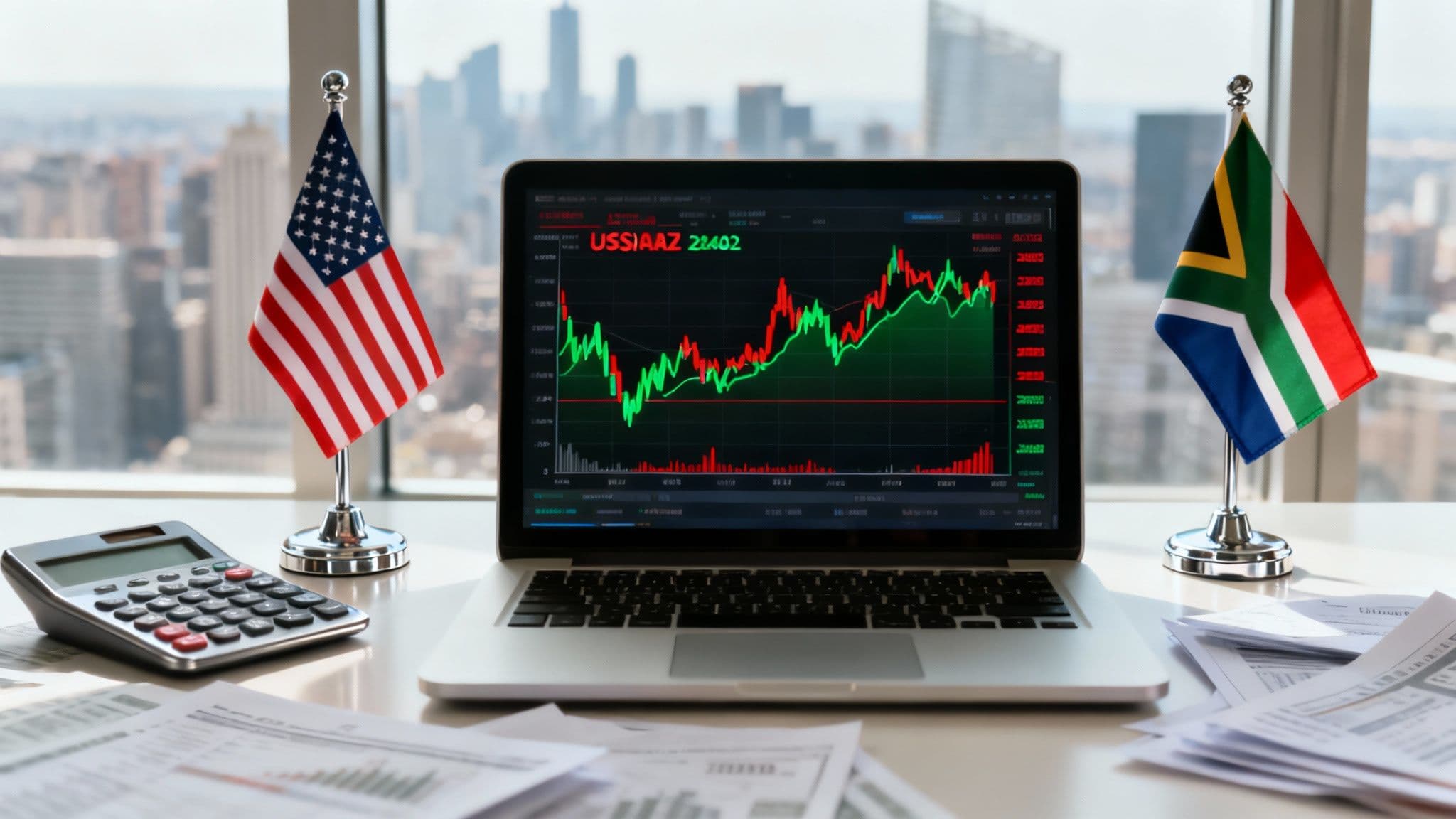
The USD/ZAR live rate is simply the real-time price of one US dollar in South African rand. But for any business trading internationally, it's far from a simple number. It's a constantly moving target that directly hits your bottom line with every single transaction.
What the USD/ZAR Live Rate Means for Your Business
Think of the USD/ZAR live rate as a dynamic price tag on the US dollar, and for South African businesses, it's a powerful force shaping your financial health. It’s not some abstract figure for traders on Wall Street; it's what dictates the final cost of your imported goods, the true value of your exports, and ultimately, your profit margins.
Let's make it real. Say the rate moves from R18.20 to R18.50 in a short period. If you're an importer paying a $100,000 invoice, that small shift just cost you an extra R30,000. On the flip side, an exporter receiving that same $100,000 has just gained R30,000. These aren't minor blips; they are swings that can make or break your budget.
From Passive Observer to Active Strategist
Watching the currency market without a plan is like watching the JSE without investing—you’re leaving money on the table. When you just accept whatever rate the market gives you on the day a payment is due, you're injecting a massive dose of uncertainty into your financial planning.
By actively monitoring the live rate, you turn a potential risk into a strategic advantage. It gives you the power to time payments, lock in profits, and secure a competitive edge.
For any business involved in global trade, understanding and acting on the USD/ZAR live rate is no longer a "nice-to-have." It’s a core part of sharp financial management. It directly influences:
- Cost of Goods: The rate determines the final rand cost for any components, machinery, or finished products you source from overseas.
- Export Revenue: It impacts the total amount of rand you pocket after converting your dollar-denominated sales.
- Budgeting Certainty: High volatility can throw your cash flow forecasts into chaos and make long-term planning a serious headache.
In the end, getting a handle on this rate helps you shift from being a price-taker to a strategic decision-maker. You stop reacting to the market and start protecting your bottom line from its unpredictable swings.
The Economic Forces That Move the Rand
The usdzar live rate doesn't just move on a whim. It’s caught in a constant economic tug-of-war between what’s happening in South Africa and the United States. If you’ve ever wondered why the Rand strengthened yesterday only to weaken today, the answer usually lies in a few key areas: interest rates, commodity prices, and the general mood of global investors.
Getting a handle on these factors is the first step to making sense of the market’s movements and protecting your business from nasty currency surprises.
Interest Rates: The Global Money Magnet
Think of interest rates as a magnet for international capital. When the South African Reserve Bank (SARB) decides to raise interest rates, it’s essentially making Rand-based investments more appealing by offering higher returns. This tends to pull in foreign investors, who then need to buy Rands, increasing demand and strengthening our currency against the US dollar.
But it’s a two-way street. When the US Federal Reserve hikes its rates, the US dollar suddenly becomes the more attractive option. Capital then flows out of emerging markets like ours and heads towards the US. This strengthens the dollar, and you’ll typically see the USD/ZAR rate climb as a result. It’s a delicate dance, where decisions made in Pretoria and Washington D.C. have a direct impact on the cost of your international payments.
Commodities and Confidence
South Africa’s economy is built on its rich natural resources. We're a major exporter of gold, platinum, and other precious metals, and here’s the crucial part: those commodities are all priced in US dollars. This directly links the country's economic health to global commodity markets.
When commodity prices are high, a flood of US dollars pours into South Africa. This influx increases the supply of dollars and, in turn, boosts the Rand’s value. It’s one of the most powerful levers affecting the exchange rate.
Beyond hard assets, there's the softer, but equally important, factor of investor sentiment. Good news—like political stability or positive economic forecasts—builds confidence, encouraging foreign investment and giving the Rand a lift. On the flip side, even a hint of uncertainty can send investors running for the exit, pulling their capital out and weakening the currency almost overnight.
These forces combine to create a deeply dynamic, and often volatile, environment. Just look at recent history. In the six months between May and November 2025, the Rand strengthened by about 3.49% against the dollar, but not before swinging wildly from a high of R18.216 to a low of R17.052. You can explore more historical rate fluctuations to see these economic forces in action.
This kind of volatility is exactly why every South African business involved in international trade needs to keep a close eye on what’s driving the live rate.
How to Read Live Rate Charts and Spot Trends
At first glance, a live currency chart can look like a jumble of jagged lines. But for a business dealing in US Dollars and South African Rands, that chart tells a story—a story you can learn to read. Once you do, you'll be able to move from just accepting a rate to actively timing your international payments for the best possible outcome.
It starts with the basics. If the line on the USD/ZAR live rate chart is climbing, the Rand is weakening. It’s taking more ZAR to buy a single USD. If the line is falling, the Rand is getting stronger, which is great news if you’re importing from the US. This simple up-and-down movement is the first clue to spotting your opportunities.
To really get to grips with what the market is doing, you'll want to understand the fundamentals of reading market data. If you're new to this, there are some excellent resources out there, like this practical guide on how to read forex charts.
Identifying Key Chart Elements
Going beyond a simple line, you'll often see something called a "candlestick chart." It might look complex, but it gives you a much richer picture of the market. Each "candle" quickly shows you the opening, closing, highest, and lowest prices for a set period. In one quick look, you can gauge volatility and get a feel for market sentiment.
The goal is to look at a USD/ZAR chart and see opportunities and risks, not just confusing lines. Understanding these visual cues empowers you to make smarter, more timely financial decisions.
Context is everything. Looking back at historical data helps you understand the Rand’s typical behaviour. For example, records show that in August 2025, the daily rates swung between 17.777 and 17.904 ZAR to the Dollar. Fast forward to the week before 21 November 2025, and the average was closer to 17.165 ZAR. This typical range of roughly R17 to R18 per dollar gives you a solid benchmark to judge whether today's live rate is a good deal or not.
As we've discussed, it's not just about the numbers; external factors like interest rates and commodity prices have a huge impact. This infographic neatly shows how these elements often interact.
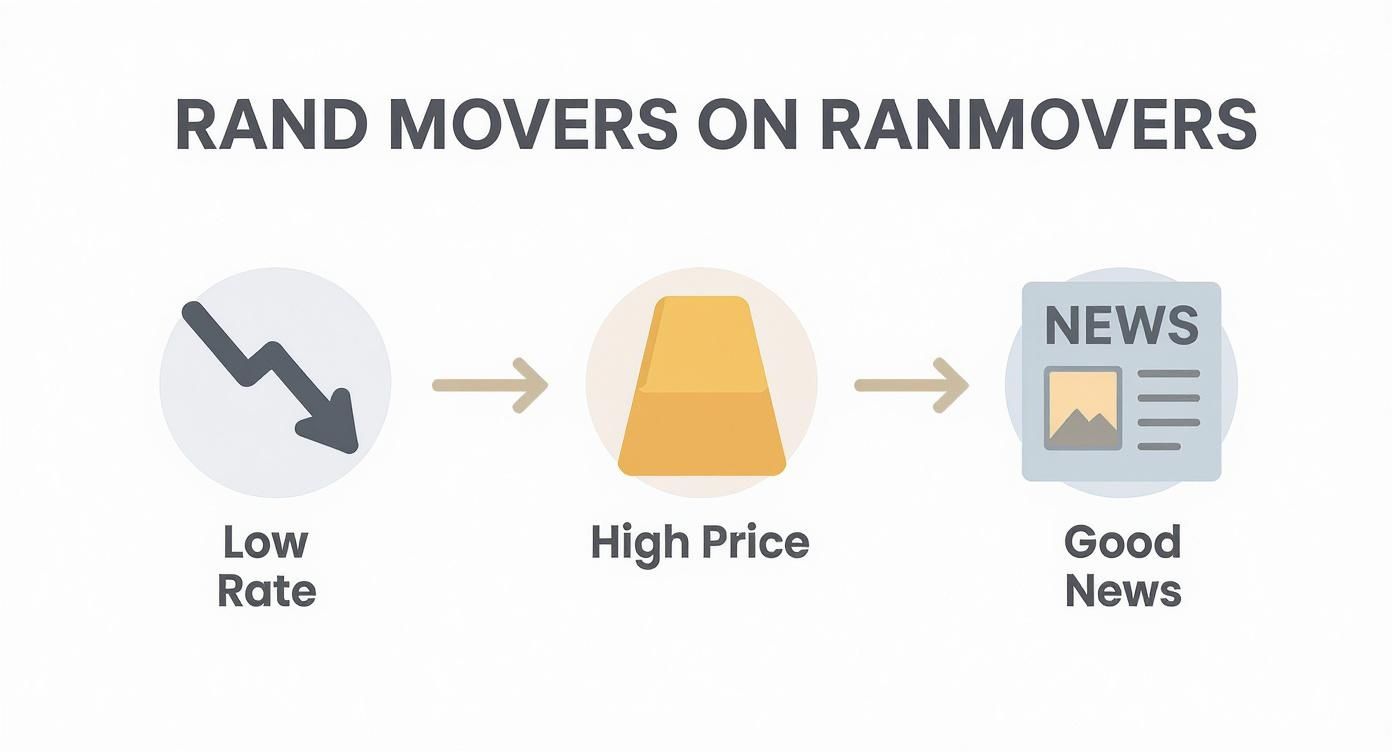
As you can see, something like a high gold price can give the Rand a welcome boost. It’s a handy visual reminder of the key market drivers you should be watching.
Key Terms on a Live Rate Chart
To help you get started, here’s a quick reference guide for some of the common terms you'll encounter on a USD/ZAR live rate chart.
| Term | What It Means for Your Business |
|---|---|
| Bid Price | The price a broker is willing to pay for USD. This is the rate you get if you're selling dollars. |
| Ask Price | The price a broker is willing to sell USD for. This is the rate you get if you're buying dollars. |
| Spread | The small difference between the Bid and Ask prices. This is how brokers make their money. A smaller spread is better for you. |
| High / Low | The highest and lowest points the rate reached in a given period (e.g., the last 24 hours). This shows you the day's volatility. |
| Candlestick | A visual that shows the open, close, high, and low prices for a specific time. A green candle often means the price closed higher than it opened (strengthening USD); a red one means it closed lower (weakening USD). |
Understanding these simple terms removes the mystery from the charts and turns them into a practical tool for your business's financial strategy.
Finding a Rate You Can Actually Trust
When you pull up the USD/ZAR live rate on a search engine, you're looking at the mid-market rate. Think of it as the true, wholesale price of the currency—the perfect midpoint between what global buyers are willing to pay and what sellers are asking for at that very moment. It's the purest rate out there.
But here’s the catch most businesses run into: the rate you see online is rarely the rate you actually get.
Your typical bank or payment provider won’t offer you that clean mid-market rate. Instead, they give you a slightly less favourable one and keep the difference for themselves. This hidden markup is called the spread, and it’s a silent drain on your company's profits. It’s the gap between the real rate and the one quoted to you, and it’s how many institutions make money on your international payments without ever listing it as a fee.
The Hidden Cost of the Spread
Let's put this into perspective. Imagine you need to pay an international supplier $50,000. The true mid-market rate is R18.30. Your bank, however, quotes you R18.55. That small R0.25 difference is their spread.
It might not sound like much, but on that single payment, it costs your business an extra R12,500.
The spread isn't just a small commission; it's a hidden tax on your international business activities. Over dozens of transactions, this seemingly minor markup can erode tens or even hundreds of thousands of Rands from your annual profits.
Finding a transparent rate isn't just good practice; it's essential for smart financial management. A solid first step is understanding currency conversion fundamentals to see where these costs are buried.
The real goal is to find a partner who gives you direct access to the spot rate—the same live rate banks use when they trade with each other. At Zaro, we’re built on transparency. We provide the real-time, mid-market USD/ZAR live rate with zero spread. The rate you see is the rate you get, simple as that. This approach completely removes hidden costs, giving you clarity and delivering significant savings.
Comparing Rate Sources for a $50,000 Payment
The difference between a spread-based rate and a true spot rate becomes incredibly clear when you look at the numbers for a sizeable transaction. Here’s how a $50,000 payment could play out.
| Provider Type | Advertised Rate | Spread (Hidden Cost) | Total ZAR Cost | Potential Savings |
|---|---|---|---|---|
| Traditional Bank | R18.55 | R0.25 per USD | R927,500 | - |
| Zaro (Spot Rate) | R18.30 | R0.00 | R915,000 | R12,500 |
As the table shows, the "small" spread from a traditional provider adds up to a substantial hidden fee. Choosing a provider that offers the true spot rate means that R12,500 stays in your business, where it belongs.
Practical Strategies to Manage Currency Risk
Knowing what moves the USDZAR live rate is one thing, but acting on that knowledge is what truly protects your business. If you just accept whatever the market rate is on the day your payment is due, you're essentially gambling with your profits.
Fortunately, there are proven ways to shield your business from this volatility. These strategies, broadly known as hedging, aren't just for massive corporations with dedicated trading desks. They are practical tools any business can use to bring certainty to its budget and protect its bottom line.
Let's break down the two most common and effective methods: forward contracts and currency options.
Locking in Certainty with Forward Contracts
A forward contract is probably the most direct way to eliminate currency risk. Think of it as pre-booking your exchange rate. It's a simple agreement where you lock in a rate today for a currency exchange that will happen on a specific date in the future.
Let’s say you’re an importer and you have a $100,000 invoice to pay in three months. The rate today is a decent R18.20. Instead of waiting and hoping for the best, you can enter into a forward contract to buy those dollars at R18.20.
Now, your payment is fixed at exactly R1,820,000. It doesn't matter if the live rate shoots up to R19.00 or drops to R17.50 in those three months; your cost is locked in.
A forward contract is your insurance policy against nasty surprises. It takes all the guesswork out of your international payments and makes your cash flow forecasting rock-solid.
This tool is perfect for businesses that need absolute certainty. You do trade away the potential to benefit if the rate moves in your favour, but in return, you get total protection from any negative swings.
Gaining Flexibility with Currency Options
If you want protection but don't want to miss out on potential upside, a currency option is a great fit. It gives you the right, but not the obligation, to exchange currency at a pre-agreed rate on a future date. You pay a small upfront fee, called a premium, for this flexibility.
Let's go back to that $100,000 payment. You could buy an option giving you the right to purchase US dollars at, say, R18.40. Here’s how it plays out:
- If the live rate weakens to R18.80, you simply exercise your option. You get to buy your dollars at the protected rate of R18.40, saving a significant amount.
- If the live rate strengthens to R18.00, you just let the option expire and do nothing. You then buy your dollars on the open market at the better R18.00 rate.
An option acts as a safety net. It caps your losses if the market moves against you but still lets you take advantage of favourable movements. It’s the ideal tool for businesses that want to guard against the worst-case scenario without giving up on the best-case one.
Building a Smarter International Payment Workflow

Knowing the live rate is one thing, but actually using that knowledge to protect your profits is where the real work begins. It’s about building a simple, repeatable process that takes the guesswork out of your foreign exchange.
This isn't about getting bogged down in complex financial modelling. It's about having a disciplined checklist for every single international payment. That’s how you move from reacting to market swings to confidently managing them.
An Actionable Four-Step Process
Here’s a straightforward framework you can put into practice right away.
Monitor with Clarity: Keep a close eye on the usdzar live rate using a source you can trust. Steer clear of rates with hidden markups and focus on the real mid-market number—that’s your true benchmark.
Analyse with Context: Look at the market’s movements and think about your own business. Do you have a big supplier payment coming up? Are you about to receive a large dollar-based invoice payment? The context is everything.
Decide Proactively: With your analysis in hand, it’s time to choose a strategy that fits your risk tolerance. Does it make sense to lock in the rate with a forward contract now, or do you have enough wiggle room in your budget to wait for a better opportunity?
Execute with Efficiency: When you’re ready to transact, use a platform that offers zero spread and keeps fees to a minimum. This last step is crucial—it ensures all your careful planning doesn't get eaten away by hidden costs right at the finish line.
By weaving this workflow into your regular financial operations, you stop treating currency risk as an unpredictable threat. Instead, it becomes just another manageable part of your business strategy, helping you secure your bottom line.
Got Questions About the USD/ZAR Rate? We've Got Answers.
When you're dealing with the USD/ZAR live rate, a lot of practical questions pop up. Let's tackle some of the most common ones so you can move from wondering to acting with confidence.
What’s the Best Time of Day to Make a Payment?
While there’s no magic hour, your best bet is often when market activity is at its peak. This usually happens during the overlap of the London and New York trading sessions, which falls between 3 PM and 6 PM South African time.
During this window, higher trading volumes generally lead to tighter spreads and more stable pricing. Just remember, major economic news can throw a spanner in the works and cause volatility at any time.
Spot Rates vs. Forward Rates: What’s the Real Difference?
Think of it this way: a spot rate is for the here and now. It’s the live price you get for a currency exchange that settles almost immediately (typically within two business days).
A forward rate, on the other hand, is for the future. It’s a rate you agree on and lock in today for a transaction that will happen weeks or months down the line. It's your way of protecting your budget from nasty surprises if the market moves against you.
The key difference is timing and certainty. A spot transaction handles today's needs at today's price. A forward contract secures tomorrow's price today, taking future currency risk off the table.
Can News Really Move the Rand That Fast?
Absolutely, and sometimes with breathtaking speed. A surprise interest rate decision from the US Federal Reserve or our own South African Reserve Bank can send the USD/ZAR live rate jumping in a matter of minutes.
It’s not just about interest rates, either. Major political developments or unexpected economic data, like a sudden spike in inflation, can instantly change how investors feel about the rand, causing immediate and significant swings.
Ready to take control of your international payments with rates you can trust? With Zaro, you get the real mid-market exchange rate with zero spread and no hidden fees. Sign up today and see how much you can save.