
If you're just starting out in forex, you'll hear a lot of terms thrown around. But if there’s one number you absolutely must understand, it's your equity.
Think of it this way: your forex equity is the real-time, live value of your trading account. It's not just your starting deposit; it’s that deposit plus or minus the profit or loss from all your currently open trades. It's the most accurate snapshot of your financial standing at any given moment.
What Is Forex Equity in Simple Terms?

Many new traders get confused between their account balance and their equity. The balance is static—it only updates when you close a trade. Your equity, on the other hand, is constantly on the move, fluctuating with every single price tick in the market. This makes it the truest measure of your account's current worth.
Here’s an analogy that might help. Imagine buying a house. Your initial deposit is like your account balance. But the actual value of your house changes daily based on the property market. That current, real-world value is your equity. If your open trades are winning, your equity will be higher than your balance. If they're losing, it will be lower.
Why Equity Is Your Most Important Number
When it comes to making trading decisions, your broker isn't looking at your balance. They're looking at your equity. This single figure is what determines whether you can open new positions or how much of a loss you can sustain before things get serious. All your risk management strategies hinge on this number.
Equity is the truest measure of your account's financial health. It tells you not just what you started with, but where you stand at this exact moment in the market.
This is why experienced traders watch their equity like a hawk. It’s your built-in early warning system. A sudden drop in equity is a massive red flag that your positions are moving against you and need attention—long before you get a dreaded margin call.
To get a clearer picture, it helps to break down what actually goes into calculating your equity. This table lays out the core components, offering a quick reference for how each one affects the final number you see on your screen.
Forex Equity Key Components at a Glance
| Component | Description | Impact on Equity |
|---|---|---|
| Account Balance | The amount of money in your account before accounting for open positions. It only changes when you deposit, withdraw, or close a trade. | This is the starting point for your equity calculation. |
| Unrealised P/L | The total profit or loss (P/L) from all your currently open trades. This value is "unrealised" because the trades haven't been closed yet. | A positive P/L increases your equity above your balance. A negative P/L decreases it below your balance. |
| Margin | The amount of your capital that is locked up by your broker to keep your current positions open. It's a good-faith deposit, not a fee. | While margin is part of your equity, it's not available to be used for new trades. Low usable margin can be a risk signal. |
In short, each of these elements plays a crucial role. Understanding how they interact is fundamental to managing your account effectively and making smarter trading decisions.
Calculating Your Live Forex Equity
So, how do you work out your forex equity in real-time? Thankfully, it’s not some complex Wall Street formula. It's a straightforward calculation that gives you the true, live value of your trading account at any given moment.
Think of it this way:
Equity = Account Balance + Total Unrealised Profit or Loss (P/L)
Your account balance is the money you had before you opened any current trades. The moving part is your unrealised P/L—the sum of the profits and losses from all your open positions, which fluctuates with every market tick.
A Practical Example of Equity in Action
Let's put this into a real-world context. Picture a trader based in Johannesburg who has just funded her account with R10,000.
Opening a Trade: She decides to buy the USD/ZAR pair. The second she enters the trade, her equity is still R10,000. Why? Because the position hasn't had a chance to move yet, so there's no profit or loss.
When a Trade Goes Right: A few hours pass, and the market moves in her favour. Her open trade is now showing an unrealised profit of R750. Her equity has grown to R10,750 (R10,000 Balance + R750 Profit). Her account balance won't change until she closes the trade, but her account's actual value has increased.
When a Trade Goes Wrong: Now, let's imagine the opposite happened. The trade moved against her, creating an unrealised loss of R400. Her equity would immediately drop to R9,600 (R10,000 Balance - R400 Loss). This dip in equity is a crucial signal that her account can now withstand less risk.
This simple maths is the key to understanding what is forex equity. It’s not just a number on your screen; it's the most accurate measure of your account’s health, empowering you to manage risk and make smarter decisions as the market ebbs and flows.
How Equity And Margin Dictate Your Trading Power
Let's try a simple analogy. Think of your forex equity as the foundation of your trading house. Margin, on the other hand, is the loan your broker gives you to build a bigger house—that is, to control larger positions than your own capital would normally allow. A strong foundation can support a significant loan, but a shaky one can't. This is the crucial link between your equity and your actual trading power.
Whenever you open a trade, your broker effectively sets aside a slice of your capital. This is your Used Margin. It's still your money, but it's temporarily locked up as a good-faith deposit to secure your open positions. What's left over is your Free Margin—the capital you can still use to open new trades or, just as importantly, to absorb losses on your current ones.
This infographic shows that direct, real-time connection between your account's core value and its ever-changing health.
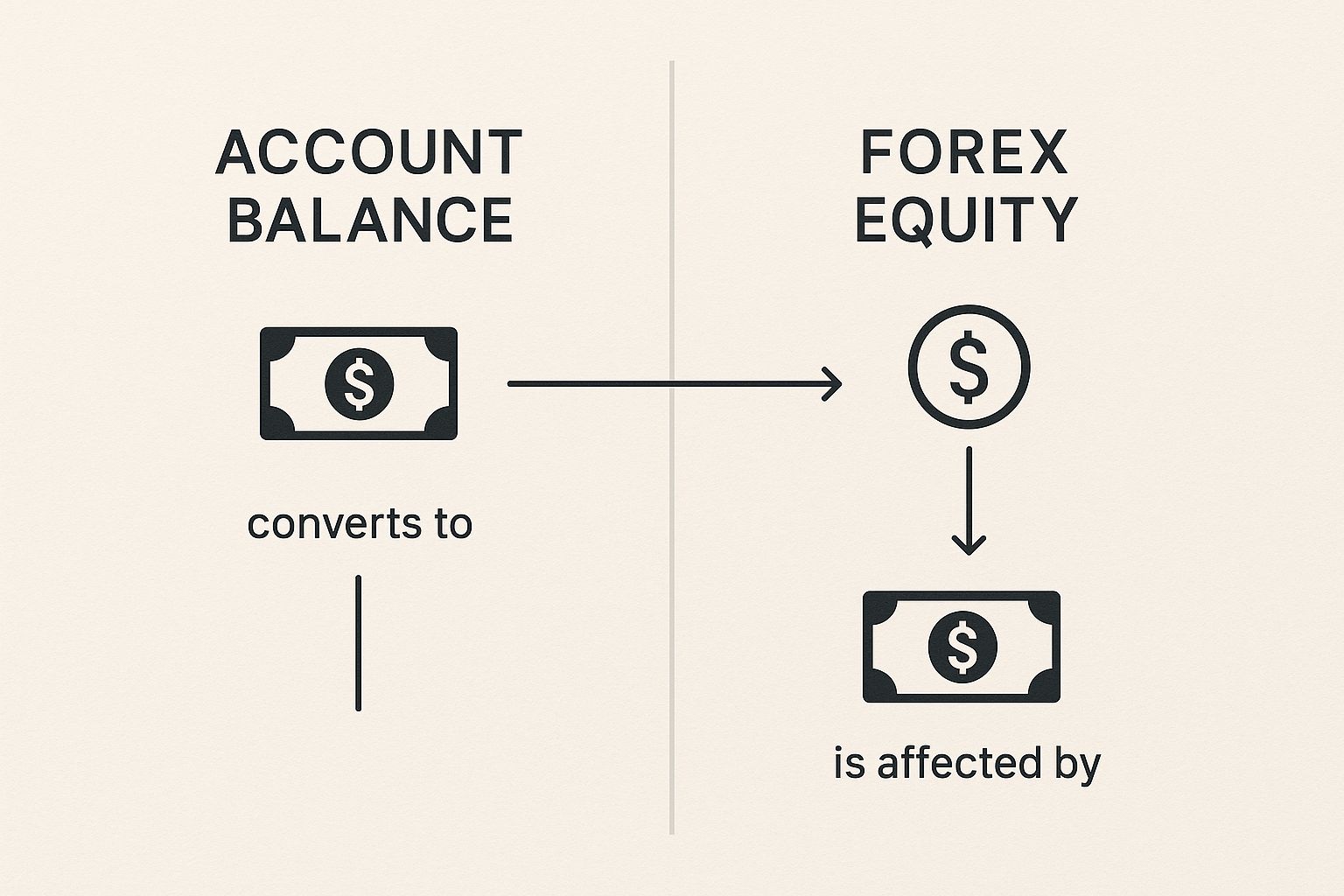
The key takeaway here is that while your balance is a static number (reflecting your last deposit or closed trade), your equity is the live, breathing figure that truly matters once you have skin in the game.
How A Drop In Equity Shrinks Your Options
Your equity level has a direct and immediate impact on how much free margin you have to work with. The relationship is simple but powerful:
Free Margin = Equity - Used Margin
As you can see from this formula, if your open trades start losing money, your equity drops. And when equity drops, your free margin shrinks right alongside it. This is where things can get dicey for a trader. A shrinking free margin severely limits your ability to manage your account effectively.
- You can’t open new trades: A fantastic opportunity might pop up, but without enough free margin, you're stuck on the sidelines.
- Your risk buffer disappears: Free margin is the cushion that absorbs floating losses. Once that cushion is gone, your account is teetering on the edge.
This is precisely why maintaining a healthy equity level is your ultimate financial safety net. It’s not just some number on your trading platform; it’s the vital resource that gives you flexibility, supports your positions, and protects you from being unceremoniously forced out of the market. Keeping a close eye on it isn't just good practice—it's the cornerstone of sound risk management.
Using Your Equity to Dodge a Margin Call
A margin call is one of the most dreaded notifications in forex trading, and your equity is what stands between you and that warning. Put simply, it’s a message from your broker telling you that your account is in trouble. It means your floating losses are eating away at your equity, and you're getting dangerously close to not having enough funds to keep your trades open.
This isn’t just some abstract concept; it’s a crucial mechanism that protects both you and your broker from catastrophic losses. Think of your equity as the fuel gauge for your trading account. A margin call is the low-fuel warning light blinking on your dashboard. If you ignore it, you’re heading for a complete shutdown known as the stop-out level.
From a Warning to a Forced Closure
What happens if a trade keeps going against you after that margin call? Your equity will continue to plummet. Once it drops to the broker’s specific stop-out level (often a set percentage, like 50% of your required margin), their system takes over. It will automatically start closing your positions, usually starting with the most unprofitable one, to release margin and get your account back above the danger zone.
Let's imagine how this plays out:
- You open a position, but the market moves against you, causing your R15,000 equity to drop.
- As the losses mount, your equity falls to the broker's margin call level, say R5,000. You'll get an alert.
- You either don't see it or hope for a turnaround, but the trade worsens. Your equity now hits the R2,500 stop-out level. Instantly, your broker’s system closes the losing trade to stop you from going into debt.
The secret is to never let it get that far. By keeping a close eye on your forex equity, you can spot trouble long before your broker sends a formal warning. This gives you the power to close a losing trade, rethink your approach, or top up your account—all on your own terms.
This idea of maintaining a financial cushion is fundamental at every level, from a single trader's account to an entire nation's economy. Take South Africa, for instance. As the largest forex trading hub on the continent with a daily turnover exceeding $20 billion, the nation's growing forex reserves act as a buffer against currency shocks—much like your equity protects you from market volatility. You can discover more about Africa's forex trading landscape and its key economic drivers.
Actionable Strategies to Protect Your Equity
 Knowing what forex equity is gets you to the starting line. Learning how to actively protect it is how you finish the race. To grow your trading capital, you need a strong defensive game to shield your account from those inevitable, stomach-churning drawdowns. It all comes down to building solid risk management habits, which create the bedrock for long-term survival and, hopefully, profitability.
These strategies aren't rocket science, but they do demand unwavering discipline. They are the tried-and-tested principles that separate traders who manage their accounts professionally from those who are just gambling on market whims.
Let's break down three core techniques every trader must master to keep their equity safe.
Use Disciplined Stop-Loss Orders
Your stop-loss order is your number one defensive tool in the trenches. It’s a simple instruction you give your broker to automatically close a losing trade when it hits a price you've decided on beforehand. This one action puts a hard cap on your maximum acceptable loss for any single trade, defining your risk before you've even clicked the 'buy' or 'sell' button.
Trading without a stop-loss is like walking a tightrope without a safety net. It’s a recipe for disaster. A stop-loss ensures one bad decision or a sudden market move doesn't spiral out of control and wipe out a huge chunk of your equity. Think of it as your account's fire extinguisher—you hope you never have to use it, but you’ll be incredibly glad it’s there when a fire starts.
Implement Smart Position Sizing
How much of your hard-earned cash should you put on the line for a single trade? The answer lies in position sizing. A widely respected guideline among seasoned traders is the 1-2% rule. This principle is simple: never risk more than 1% or 2% of your total account equity on any one trading idea.
For instance, if you have an R10,000 account, sticking to a 1% risk limit means your stop-loss would be set at a level where you could lose no more than R100 on that trade.
By sticking to strict position sizing, you make it mathematically impossible for a short losing streak to blow up your account. It forces a professional mindset: capital preservation comes first.
This disciplined approach means you can survive a string of losses and still have plenty of capital left to trade another day. It gives your strategy the time it needs to perform and deliver winning trades.
Maintain a Positive Risk-to-Reward Ratio
Finally, you have to make sure your winning trades have a bigger impact than your losing ones. This is all about maintaining a positive risk-to-reward ratio. You should actively hunt for trade setups where your potential profit is at least twice as big as your potential loss—a ratio of 1:2 or better.
So, if you risk R100 per trade, you should be aiming for a profit of at least R200. This structure is powerful; it means you can still be a profitable trader even if you only win 40% of your trades. Your winners will more than pay for your losers, which is the secret to staying in the game long-term.
Alright, let's clear up some of the common questions that pop up when traders first get to grips with forex equity. Getting these concepts straight is crucial because they directly relate to what you see on your trading platform every single day.
Think of this as moving from theory to practice.
What’s The Difference Between Balance And Equity?
This is easily the biggest source of confusion for new traders, but the difference is actually quite simple when you break it down.
Here’s a good way to remember it: your account balance is your history, while your equity is your present reality. Your balance only changes when an action is completed — you close a trade (locking in a profit or loss), deposit more funds, or make a withdrawal. It’s the settled cash value of your account.
So, what is forex equity then? It's your balance plus the floating, unrealised profits or losses from all your currently open trades. It’s the live, real-time value of your account. As the market ticks up and down, so does your equity, giving you the most accurate snapshot of where you stand right now.
Can Forex Equity Become Negative?
Yes, it can, but it’s a very rare and dramatic situation. For your equity to dip into the negative, the market would have to move against you so fast and so violently that your losses blow past your entire account deposit before your broker can automatically close your position.
This usually only happens during extreme events, like a massive price gap over a weekend or a shocking economic news release. This is where a critical safety feature comes into play: Negative Balance Protection.
Most reputable brokers in South Africa and around the world now offer this as standard. It’s a contractual guarantee that you can't lose more money than you've deposited. If a black swan event wipes out your account, the broker will reset your balance to zero, preventing you from ending up in debt to them.
Honestly, this feature is non-negotiable. It's a fundamental safety net and a hallmark of a broker that takes client protection seriously.
How Does Leverage Impact My Equity?
Leverage is a double-edged sword, and its impact on equity is often misunderstood. Leverage doesn't actually change the equity calculation itself. What it does is dramatically amplify how quickly your equity can change.
Let's unpack that:
- Magnified Exposure: Leverage lets you control a much larger position with a small amount of your own capital (margin). This makes your account incredibly sensitive to even tiny price fluctuations.
- Accelerated P/L Swings: Because your position size is so large relative to your capital, a small price move against you will cause a much faster and more significant drop in your floating profit/loss.
- Rapid Equity Depletion: This rapid P/L swing hits your equity directly. A losing trade can eat through your equity at an alarming rate.
In short, using high leverage is like pouring petrol on a fire. It drastically increases the speed at which a losing trade can burn through your account. Managing leverage isn't just a good idea; it's a core survival skill for protecting your equity.
For South African businesses managing international transactions, understanding foreign exchange is just as critical. Zaro offers a solution to eliminate the high costs and hidden fees associated with traditional cross-border payments. By providing access to real exchange rates with zero spread, we give your business the clarity and control needed to thrive globally. Learn how Zaro can simplify your international finance at usezaro.com.