
In the world of currency trading, a pip is the smallest standard jump in value between two currencies. Think of it as the cents to the rand. While it seems tiny, these small movements are the heartbeat of the foreign exchange market.
For most currency pairs, like the ever-popular EUR/USD, a pip is the change in the fourth decimal place (0.0001). For South African businesses, understanding what a pip really means is crucial. Those tiny shifts can add up to a massive difference in the final cost of an international payment or the rand value of your export sales.
Getting to Grips With Currency Pips
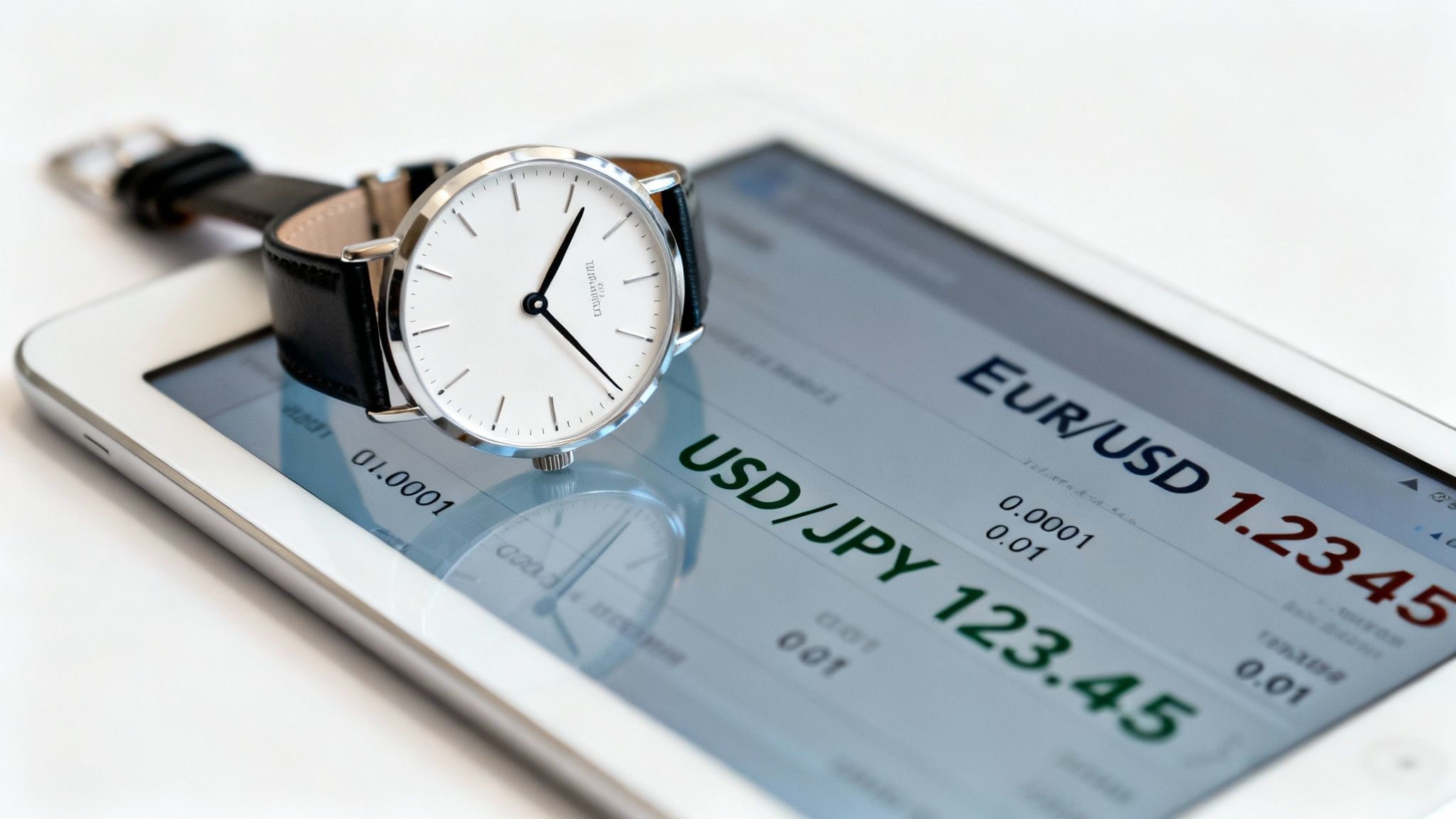
Here's a simple analogy: imagine a pip is like a single grain of sugar. One grain is hardly noticeable. But when you're dealing with a large shipment, thousands of those tiny grains add up to serious weight and value. It’s the same with currency; a single pip feels insignificant, but across a large transaction, the total movement can dramatically impact your bottom line.
A pip, which stands for "percentage in point" or "price interest point," is really just a standard unit to make talking about currency movements easy and consistent. For any South African business sending or receiving money across borders, these small changes are ticking over constantly, affecting your real-world costs.
How Pips Differ Between Currency Pairs
It's important to know that not all pips are created equal. The decimal place that represents a pip changes depending on the currency pair you're looking at. This detail is vital for correctly calculating your costs and potential profits or losses.
- Most Major Pairs: For the big players like EUR/USD, GBP/USD, and crucially for us, USD/ZAR, a pip is the fourth decimal place. So, if the USD/ZAR rate moves from R18.5000 to R18.5001, that’s a one-pip shift.
- Japanese Yen (JPY) Pairs: The yen is a bit different. Pairs like USD/JPY are quoted to just two decimal places. In this case, a pip is the second decimal place (0.01). A move from 145.50 to 145.55 is a five-pip change.
The Pipette: A Fraction of a Pip
To get even more precise, many brokers now quote prices with an extra decimal place. This tiny, fractional pip is known as a pipette, and it’s worth one-tenth of a standard pip.
So, if you see a USD/ZAR quote like R18.50005, that final '5' is the pipette. While this level of detail is a big deal for automated, high-frequency traders, most businesses can comfortably focus on the full pip for their strategic planning and risk management.
For a South African business, understanding the concept of a pip isn't just theory. It's the basic language of foreign exchange costs and risk, directly shaping the financial outcome of every international invoice you pay or receive.
To make this clearer, let's break down these concepts in a simple table.
Pips and Pipettes At a Glance
The table below provides a quick summary of how pips and pipettes are represented across the most common currency pairs a South African business might encounter.
| Concept | Most Currency Pairs (e.g., EUR/USD) | JPY Pairs (e.g., USD/JPY) | ZAR Pairs (e.g., USD/ZAR) |
|---|---|---|---|
| Standard Pip | The 4th decimal place (0.0001) | The 2nd decimal place (0.01) | The 4th decimal place (0.0001) |
| Pipette (Fractional Pip) | The 5th decimal place (0.00001) | The 3rd decimal place (0.001) | The 5th decimal place (0.00001) |
This at-a-glance view helps reinforce that while the concept is universal, the application changes depending on the currency. Always double-check which decimal place matters for the pair you're trading.
How to Calculate Pip Value for Your ZAR Transactions
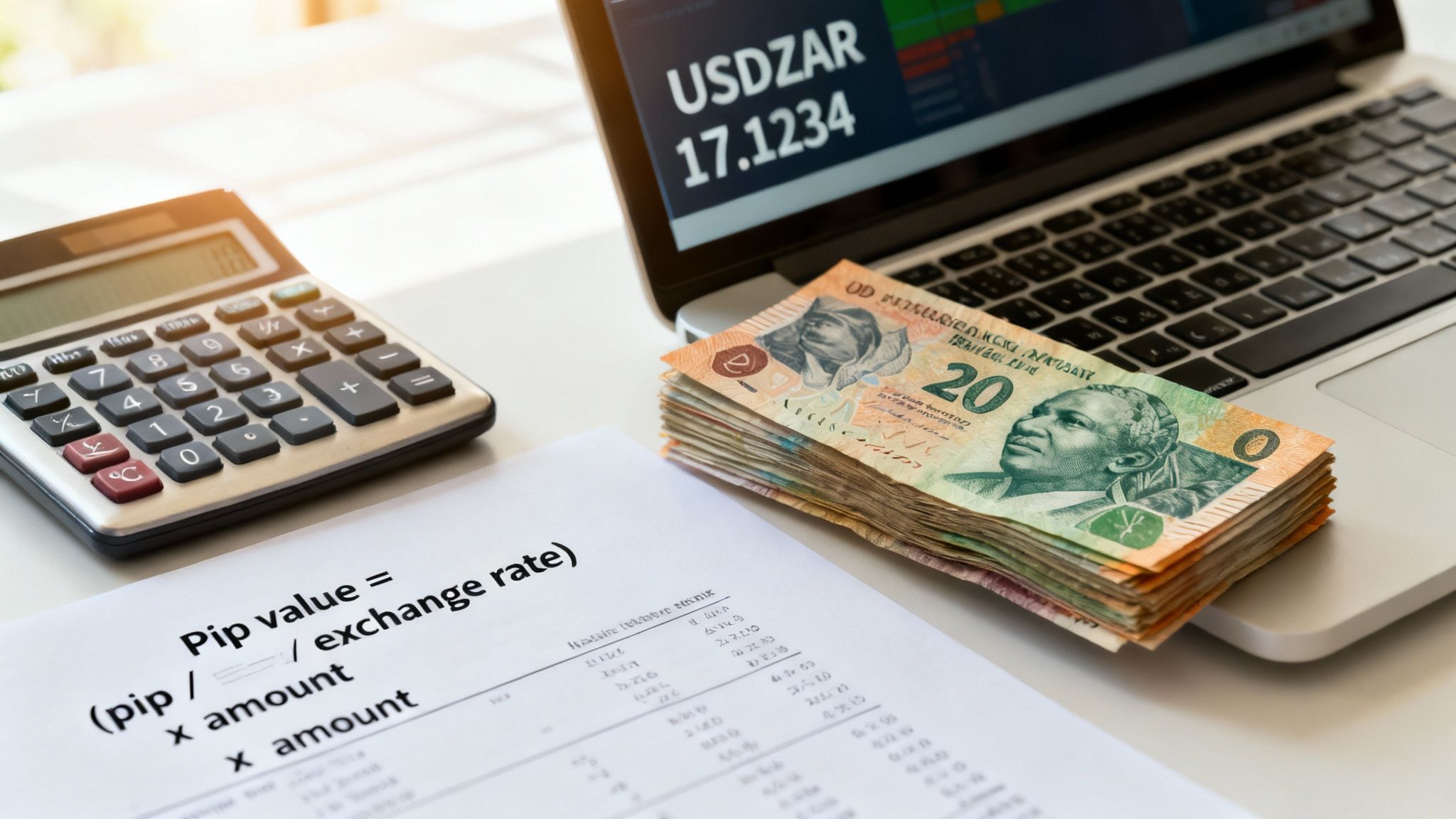
Alright, so you know what a pip is. That's the first step. But for any South African business dealing internationally, the real question is: what is that tiny movement actually worth in rands? This is where we translate a small decimal point change into a real-world financial impact on your bottom line.
The truth is, a pip’s value isn't a fixed amount. It all comes down to two things: the size of your transaction and the currency pair you're dealing with. A one-pip move on a small payment might be pocket change, but on a large invoice, it can easily swing your profit or loss by thousands of rands.
By calculating the pip value, you can finally put a number on your foreign exchange (FX) risk. You'll move from vaguely knowing that a rate change hurts to being able to say exactly how much it hurts.
The Basic Formula for Pip Value
There's a straightforward formula to figure out the monetary value of a pip. It's a must-know for any business planning around international payments.
Here’s what you need:
- The Pip Size: For USD/ZAR, this is 0.0001.
- Your Transaction Amount: The total value of your payment or receipt in the base currency (e.g., US Dollars).
- The Exchange Rate: The current rate between the two currencies.
The formula itself is simple: Pip Value = (Pip Size / Exchange Rate) x Transaction Amount. This little equation is the key to turning an abstract market shift into a concrete rand value you can actually use for risk management.
Once you start using it, the conversation changes from "the rand weakened" to "that move in the rand just cost us R15,000 on that invoice."
Worked Example: A Payment to a US Supplier
Let's walk through a real-world scenario. Imagine your business needs to pay a US supplier an invoice for $54,000.
First, we need a realistic exchange rate. As a reference, you can explore historical data and currency trends for valuable insights on South African currency movements.
For this example, let's say the exchange rate is USD/ZAR = 18.5185.
Lay out the numbers:
- Transaction Amount = $54,000
- Pip Size = 0.0001
- Exchange Rate = 18.5185
Calculate the value of one pip in US Dollars:
- Pip Value (USD) = (0.0001 / 18.5185) x 54,000
- Pip Value (USD) = $0.2916
Now, convert that pip value into rands:
- Pip Value (ZAR) = $0.2916 x 18.5185
- Pip Value (ZAR) = R5.40
This is the number that matters. For this $54,000 transaction, every single pip the exchange rate moves is worth R5.40.
A seemingly tiny 10-pip move against you now has a clear cost: R54. A more significant 100-pip swing—which is fairly common in our volatile market—would cost your business R540. Suddenly, that fourth decimal place doesn't seem so small anymore.
How Pip Movements Hit Your Bottom Line in the Real World

Calculating pip value isn't just a bit of financial maths. This is where those tiny decimal point shifts stop being abstract and start directly impacting your business's profit and loss. It's the moment the idea of what a pip is in currency trading becomes a hard financial reality.
For any South African business dealing with international suppliers or customers, every single pip movement on an invoice is either a gain or a loss. While they seem insignificant on their own, these small changes add up fast, sometimes turning a profitable deal into a loss or giving you an unexpected revenue boost.
Ignoring these movements is like sailing without a rudder—you're basically leaving your financial results to the mercy of the market. Let’s walk through two common scenarios to see just how this plays out for South African business owners.
Scenario 1: A Favourable Move for a South African Exporter
Picture a wine exporter in Cape Town. They’ve just sold a large shipment to a buyer in the United States for $100,000. When the invoice was sent, the USD/ZAR exchange rate was sitting at 18.4500, so they were expecting to bank R1,845,000.
But, as it often happens, the payment gets delayed by a week. In that time, the rand weakens a bit, and by the time the payment is processed, the USD/ZAR rate has moved to 18.5700. That’s a 1,200-pip change (18.5700 - 18.4500 = 0.1200).
Let's see what that did to their numbers:
- Original Expected Revenue: $100,000 x 18.4500 = R1,845,000
- Actual Revenue Received: $100,000 x 18.5700 = R1,857,000
That 1,200-pip movement worked entirely in the exporter's favour, adding an extra R12,000 straight to their bottom line. This is a perfect example of how currency shifts can boost your profitability without you having to sell a single extra case of wine.
This surprise windfall shows the direct link between what seems like a minor currency flutter and your actual revenue.
Scenario 2: An Unfavourable Move for a Local Importer
Now, let's flip the coin and look at it from the other side. A Johannesburg-based company imports specialised machinery from Germany and has an invoice to pay for €80,000. When they placed the order, the EUR/ZAR rate was 20.1000, so they budgeted for a cost of R1,608,000.
Unfortunately, before they can settle the invoice, the rand takes a dip against the euro. The EUR/ZAR rate climbs by 850 pips to 20.1850.
Here’s the damage:
- Original Expected Cost: €80,000 x 20.1000 = R1,608,000
- Actual Final Cost: €80,000 x 20.1850 = R1,614,800
Just like that, the importer's cost shot up by R6,800 because of an unfavourable pip movement. This extra expense comes directly out of their profit margin on the machinery.
These two scenarios make one thing crystal clear: pips aren't just for forex traders. They are a fundamental variable in your financial planning, and learning to manage the risk they create is absolutely essential for protecting your profitability.
How Hidden Spreads Inflate Your Transaction Costs
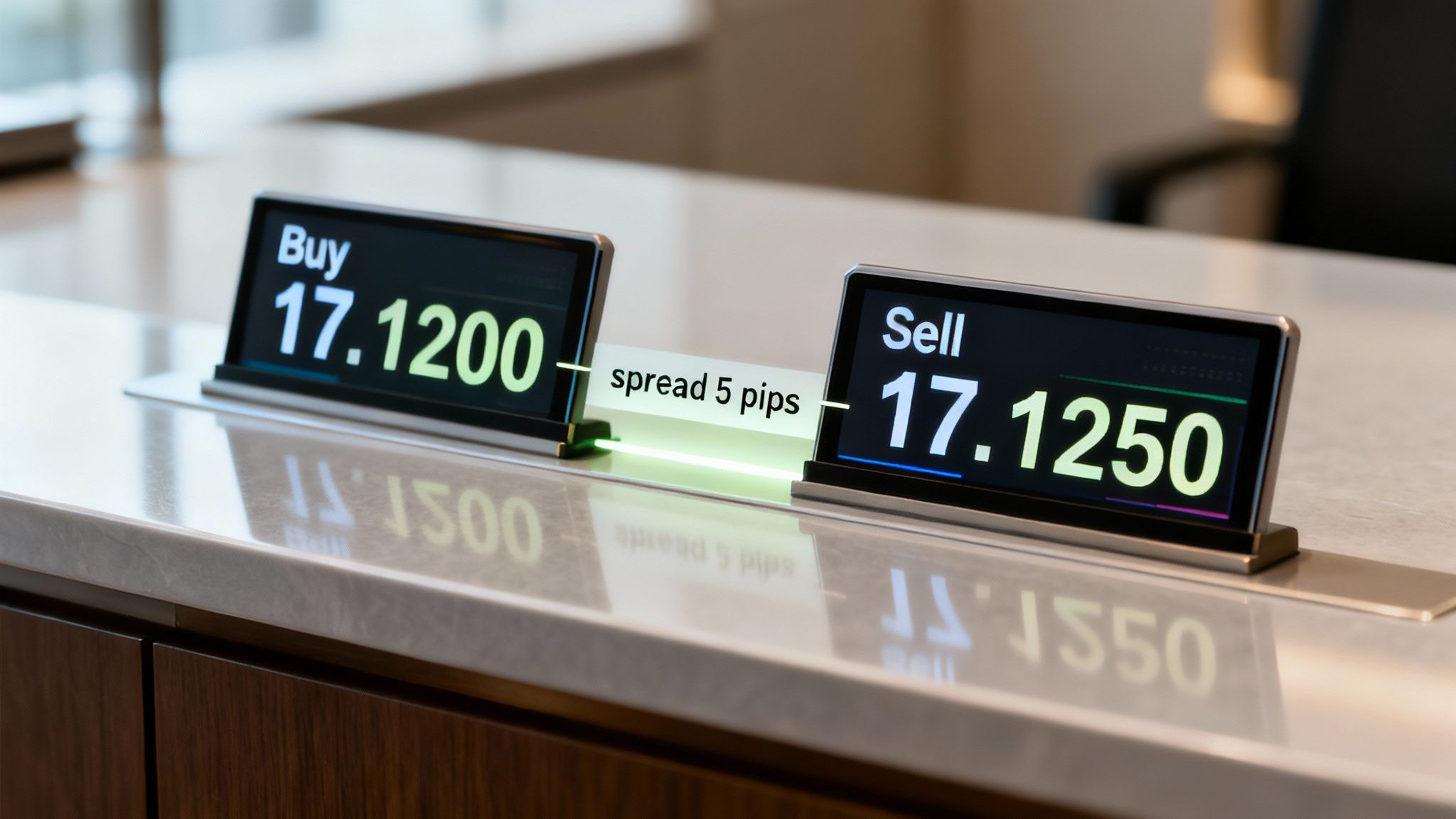
While the natural ups and downs of the market introduce risk, there's another cost baked into nearly every currency exchange you make. It’s called the spread, and it’s how most banks and brokers make their money on your international payments.
The spread is just the gap between the price a bank is willing to buy a currency from you (the bid price) and the price they’ll sell it to you (the ask price). That difference, measured in pips, is the bank's profit margin. It's a fee you pay on every single transaction, but it never shows up on an invoice.
Think of it this way: a shop owner buys a product at a wholesale price and sells it to you for more. Banks do the exact same thing with currency—they get it at the real rate and sell it to you for a few pips more.
Unpacking the True Cost of the Spread
Let's imagine the real, live USD/ZAR exchange rate is 18.5000. If you go to a bank, they won't give you that rate. Instead, they’ll show you two different prices:
- Buy Price (Bid): 18.4750 (The rate you get if you're selling your dollars to the bank)
- Sell Price (Ask): 18.5250 (The rate you pay if you're buying dollars from the bank)
The gap here is 0.0500, which translates to 50 pips. This 50-pip spread is the bank’s built-in fee.
For an importer needing to pay a $100,000 invoice, this hidden cost adds up fast. The difference amounts to a staggering R5,000! That's a serious chunk of change that quietly disappears from your bottom line.
This traditional model means you never actually trade at the real market rate. The spread guarantees the bank makes a profit simply for handling your transaction, no matter which way the market is moving.
A New Model Without Hidden Pip-Based Fees
This is exactly where innovative financial platforms are changing the game. At Zaro, our entire system is built on a zero-spread model. We've completely done away with this hidden pip-based markup.
Instead of padding the exchange rate, Zaro gives you direct access to the real spot rate.
It’s that simple. The price you see is the price you get. By removing the spread, that R5,000 cost from our example vanishes completely. This kind of transparency delivers real, measurable savings, making sure your capital goes to paying suppliers, not covering your bank's hidden profit margins.
Actionable Strategies for Managing FX Risk
Knowing how a single pip can impact your bottom line is the first step. But the real game-changer is learning how to manage that risk proactively. This is what separates businesses that thrive from those that are constantly at the mercy of market swings.
Instead of just reacting when the exchange rate moves against you, you can put strategies in place to guard your profit margins and create some much-needed financial stability.
Taking control of your FX exposure is especially critical if you're thinking about expanding your business internationally, as unpredictable currency movements can quickly derail your growth plans. With a solid plan, you move from being a passenger to being in the driver's seat of your financial future.
Lock in Rates with Forward Contracts
One of the most powerful tools in your arsenal is the forward contract. It’s a straightforward agreement that lets you buy or sell a currency at a set exchange rate on a specific date in the future.
Think of it like locking in a price for fuel before a long road trip. Let’s say you know you have to pay a supplier $100,000 in three months. A forward contract allows you to lock in today's USD/ZAR rate for that future payment, completely side-stepping any market volatility over the next 90 days.
A forward contract takes the guesswork out of the equation. It turns an unknown future cost into a fixed, predictable expense, protecting your profit margins from any nasty surprises caused by negative pip movements.
This strategy is ideal for any business that has regular, predictable international payments or invoices to manage.
Diversify Your Currency Holdings
Another smart move is to create a natural hedge by holding funds in different currencies. For many South African businesses, this simply means keeping both ZAR and USD accounts. Zaro makes this easy by giving you dedicated local accounts for both.
Here’s a practical look at how that helps:
- If you're an exporter: You can get paid in USD and keep those dollars in your USD account. There’s no pressure to convert to ZAR straight away, so you can wait for a more favourable exchange rate before making the switch.
- If you're an importer: You can top up your USD account when the Rand is performing well. Then, when it’s time to pay your international suppliers, you use the dollars you already have, shielding your business if the Rand has weakened in the meantime.
This approach gives you a huge amount of flexibility and control, letting you manage your currency exposure on your own terms.
Got Questions About Pips? Here Are Some Straight Answers
Even with a solid grasp of the basics, a few common questions always pop up when it comes to applying this knowledge to your business. Let's tackle them head-on.
Why Should My Business Even Care About Pips?
It's simple: pips are where tiny market movements become a big deal for your bottom line. For an importer, a few pips moving the wrong way on a large invoice can suddenly inflate your costs by thousands of Rands. For an exporter, that same shift could mean a welcome boost to your profits.
Think of it this way: knowing what a pip is in currency trading lets you measure your financial exposure with real numbers. This isn't just theory; it's about protecting your profit margins from the daily rollercoaster of the forex market.
A pip is the basic building block of currency risk. Once you understand it, you can accurately measure your exposure, budget with confidence, and make smart decisions to keep your business financially sound.
How Does a Zero-Spread Model Fit in With Pips?
This is a crucial point. Most banks add what’s known as a 'spread' to the exchange rate they offer you. This spread is just a markup—a few extra pips they tack on top of the real market rate to make their profit. It's essentially a hidden fee.
A zero-spread model, like the one we offer at Zaro, gets rid of that markup entirely.
You trade at the genuine, live exchange rate. No hidden pip-based costs, no smoke and mirrors. This means total transparency and very real savings on every single international payment you make or receive.
Is a High Pip Value a Good or Bad Thing?
Honestly, it’s neither. A higher pip value just amplifies the effect of any market movement. It means that for every pip the rate ticks up or down, the monetary impact on your transaction is bigger.
This can feel fantastic when the market moves in your favour, but it also dials up the risk if the rate goes against you.
The real goal for any business isn't to gamble on favourable pip movements. The smart move is to manage the risk that those pips represent. That’s how you achieve predictable cash flow and build a more stable financial foundation for your company.
Ready to stop paying hidden fees and take back control of your international payments? With Zaro, you always get the real exchange rate with zero spread. Learn more and get started today.