If you’re just getting into forex, all the charts and numbers can feel a bit overwhelming. But if you want to make sense of it all, you need to start with one core concept: the pip.
Your First Look at Pips in Forex Trading
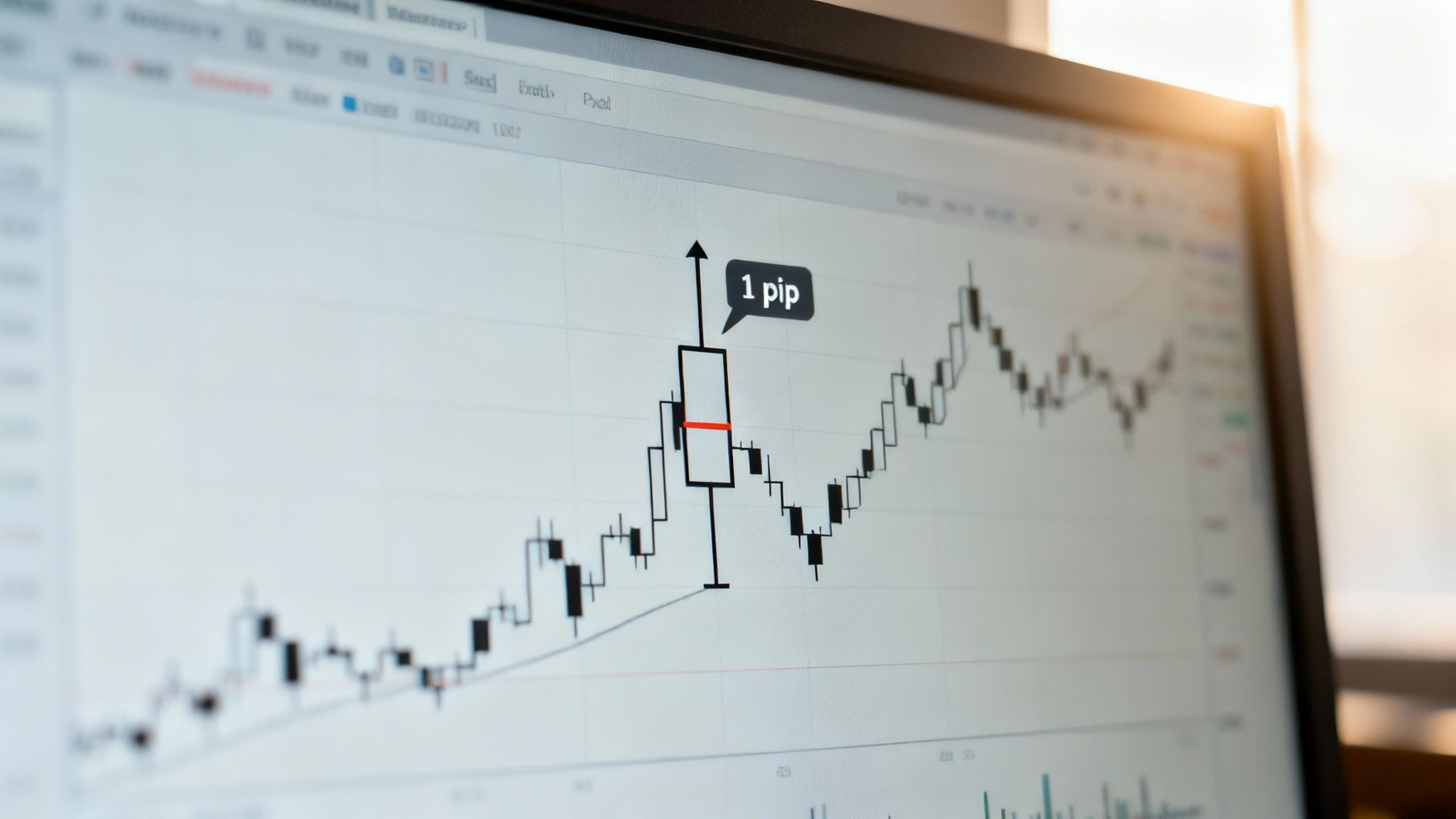
So, what exactly is a pip? The term stands for ‘Point in Percentage,’ and it’s the smallest standardised unit of measurement in the forex market. Think of it as a single 'step' a currency's price takes, whether it's moving up or down. These tiny movements are what add up to create the large price swings you see on your charts.
For the majority of currency pairs, a pip is equal to a price change of 0.0001. Let's say the EUR/USD pair moves from 1.0750 to 1.0751—that’s a one-pip increase. Simple as that. This tiny unit is the foundation for calculating your profits and losses, making it an essential piece of the trading puzzle.
Why Pips Are Essential for Traders
Getting comfortable with pips isn't just a suggestion; it's a must for any serious trader. They give you a universal language to measure performance and, more importantly, manage your risk. Without a solid understanding of pips, you’d be flying blind.
Here’s why they are so crucial:
- Calculating Profit and Loss: Pips are how you quantify how much money you’ve made or lost on a trade.
- Setting Orders: They allow you to place precise stop-loss and take-profit levels to protect your capital and lock in gains.
- Gauging Volatility: You can use pips to compare how much different currency pairs are moving, helping you choose the right market for your strategy.
For traders in South Africa, this concept is just as fundamental. Given the country's significant role in Africa's financial markets, understanding the pip's value against the Rand is key. For a pair like USD/ZAR, a pip is also typically 0.0001 of the quoted price. So, if USD/ZAR shifts from 17.5000 to 17.5001, that 0.0001 change represents one pip.
You can learn more about the growing African forex market on fnforex1.com.
How To Calculate The Real Value Of A Pip
Understanding what a pip is in forex is one thing, but the real magic happens when you connect that tiny price flicker to actual money. Figuring out what a pip is worth in rands and cents is absolutely essential for managing your trades and knowing what you stand to gain or lose.
Thankfully, you don't need a degree in advanced mathematics to do it. The formula is refreshingly simple.
Pip Value = (One Pip / Exchange Rate) x Lot Size
Let's quickly unpack that. "One Pip" is usually 0.0001 for most currency pairs. The "Exchange Rate" is just the current market price, and the "Lot Size" is the total number of currency units you're trading.
Putting The Formula Into Practice
Let's make this real with an example. Imagine you're trading a standard lot (100,000 units) of the popular EUR/USD pair, and the exchange rate is sitting at 1.0800.
- Step 1: First, divide one pip by the current exchange rate: (0.0001 / 1.0800) = 0.00009259 EUR.
- Step 2: This result gives you the pip's value in the base currency, which is euros in this case. To get the value in US dollars (the quote currency), you multiply it by the exchange rate again: 0.00009259 * 1.0800 = $0.10.
- Step 3: Finally, multiply this by the number of units in your trade: $0.10 * 100,000 = $10.
Here's a handy rule of thumb: for any pair where the USD is the second currency listed (like EUR/USD or GBP/USD), the pip value for a standard lot is always $10. This makes doing quick mental calculations so much easier when you're analysing the major pairs.
The infographic below gives you a clear picture of how even a tiny price change translates into a measurable pip movement.

As you can see, a price jump from 1.1200 to 1.1205 might look small, but that's a 5-pip gain that directly affects your trade's bottom line.
Calculating Pip Value For ZAR Pairs
For those of us trading in South Africa, knowing the pip value for ZAR pairs is non-negotiable. Let’s work through a USD/ZAR example, assuming an exchange rate of 18.5000 and a standard lot of 100,000 units.
Because the ZAR is the quote currency (the second one in the pair), the calculation is even more straightforward. We just take the pip size (0.0001) and multiply it directly by the lot size (100,000).
- Calculation: 0.0001 * 100,000 = R10.
It's that simple. In this scenario, every single pip of movement is worth R10 when you're trading a standard lot.
To show how this scales, let's look at how the value changes based on the size of your trade.
Pip Value Calculation Examples By Lot Size
This table clearly illustrates how the value of a single pip is directly tied to your trade size.
| Lot Size | Units | Pip Value (EUR/USD at 1.0800) | Pip Value (USD/ZAR at 18.5000) |
|---|---|---|---|
| Standard Lot | 100,000 | $10.00 | R10.00 |
| Mini Lot | 10,000 | $1.00 | R1.00 |
| Micro Lot | 1,000 | $0.10 | R0.10 |
As you can see, a bigger lot size means each pip movement has a much larger monetary impact. This relationship is the cornerstone of effective risk management, helping you decide how much you're willing to risk on any given trade.
Pips, Pipettes, and Japanese Yen Pairs
Just when you think you've got pips figured out, you'll see a price quote with an extra decimal place. Don't worry, your screen isn't glitching—it's just a pipette. This tiny addition allows for more precise pricing, but it can definitely trip up new traders. Let's clear up the confusion so you can read any forex quote like a pro.
So, what exactly is a pipette? Think of it as a fractional pip. It's simply one-tenth of a standard pip, giving brokers a way to offer tighter spreads and more accurate quotes.
The trick to telling them apart is all about counting the decimal places.
Spotting the Difference: Pips vs. Pipettes
For almost all currency pairs, the pip is the fourth number after the decimal point. Any digit that follows is a pipette.
Let's break down a EUR/USD quote of 1.07525:
- The digit 2 sits in the pip spot (the fourth decimal place).
- The final digit, 5, is the pipette (the fifth decimal place).
If the price climbs from 1.07525 to 1.07535, that's a one-pip move. A much smaller shift, from 1.07525 to 1.07526, is just a one-pipette change. While hyper-active scalpers might fixate on pipettes, the vast majority of traders stick to counting full pips to measure their performance.
A good rule of thumb is to keep your eye on that fourth decimal place for most pairs. The fifth digit is just extra detail, but the fourth is what really matters for calculating your profit, loss, and risk.
The Special Case of Yen Pairs
Another curveball for new traders comes from pairs involving the Japanese Yen (JPY), like USD/JPY or GBP/JPY. You’ll notice right away that they look different, quoted with only two or three decimal places.
For any JPY pair, the pip is found in the second decimal place, not the fourth. This is purely down to the Yen's value being so much smaller than currencies like the US dollar or the euro.
Take a look at a USD/JPY quote of 148.452:
- The pip here is the 5 (the second decimal place).
- The pipette is the 2 (the third decimal place).
So, if the price moves from 148.45 to 148.46, that's a one-pip increase. Getting this distinction right is absolutely essential for accurately calculating what a pip is worth across all currency pairs you might trade.
Connecting Pips to Your Profit, Loss, and Risk
Knowing what a pip is gets you started, but understanding how it impacts your trading account is where the real magic happens. Pips are the bridge connecting a tiny price flicker on your screen to the actual rands and cents you either make or lose.
Think of it this way: your total profit or loss on any trade is simply the number of pips the price moved, multiplied by the pip value for your specific trade size. This simple formula turns an abstract unit of measurement into a very real financial outcome.
A Practical USD/ZAR Trade Example
Let’s walk through a real-world scenario. Say you decide to buy one standard lot (100,000 units) of USD/ZAR. As we figured out earlier, each pip for this trade size is worth R10.
If the market moves in your favour by 50 pips, the maths is straightforward:
- Profit Calculation: 50 pips * R10 per pip = R500 profit
Of course, the market can also move against you. If the price dropped by 50 pips instead, you’d be looking at a R500 loss. This direct link is crucial, especially with volatile pairs like the rand.
To put the volatility into perspective, the USD/ZAR pair once swung from a low near 16.64 to a high of 19.93 in a single year. That’s a move of roughly 33,000 pips—a massive shift that highlights the opportunities and risks involved. You can dive deeper into South African currency dynamics on tradingeconomics.com.
Pips aren't just for tallying up your winnings. They are the fundamental building blocks of disciplined risk management, allowing you to set clear, non-negotiable boundaries for every single trade.
Using Pips for Smart Risk Management
This is where the concept of what is pips in forex trading transforms from a simple definition into a professional skill. Seasoned traders don’t just think in money; they think in pips. They use them to set the orders that protect their capital from unexpected market moves.
These orders are your automated safety nets:
- Stop-Loss Orders: This is your line in the sand. You place an order to automatically close a trade if it moves against you by a pre-set number of pips. For instance, setting a 30-pip stop-loss caps your potential loss, no matter what the market does.
- Take-Profit Orders: This is your exit plan for a winning trade. The order automatically closes your position once it hits a certain pip target, like 60 pips. This helps you secure profits before the market has a chance to reverse.
By using pips to define your exit points before you even enter a trade, you take emotion out of the equation. This is what separates amateurs from professionals—a structured, disciplined approach that’s key to preserving your capital and building long-term consistency.
Putting Your Pip Knowledge Into Practice
Alright, you've got the theory down. But knowing what a pip is and actually using that knowledge are two different things. The real leap forward happens when you start seeing the market not just in currency values, but in pips.
Think about it. When you're looking at a chart on a platform like MetaTrader 4 or its successor, MT5, and you see a currency pair move from 1.1250 to 1.1280, your brain should immediately register that as a 30-pip gain. Making that mental switch from abstract price changes to concrete pip movements is the first step to trading with a plan.
Start Thinking in Pips, Not Rands
Here's a technique that seasoned traders live by: set your trading goals in pips, not in a specific monetary amount. Why? Because it strips the emotion out of your decisions. You start focusing on the quality of your trades, not the fluctuating balance in your account.
This is how you can start to adopt that professional mindset:
- Set Pip-Based Targets: Instead of chasing a R1,000 profit, aim to capture 50 pips. This makes your goal consistent, whether you're trading a small or large position.
- Define Your Risk in Pips: Before you even enter a trade, decide how many pips you're willing to lose. Setting a 25-pip stop-loss, for instance, gives you a clear exit point.
- Measure Your Performance: At the end of the week or month, tally up your total pips gained or lost. This gives you an honest, objective look at whether your strategy is actually working.
Focusing on pips helps you build a solid risk-to-reward ratio into every single trade. For instance, if you risk 25 pips for a potential gain of 50 pips, you've established a healthy 1:2 ratio right from the start.
This methodical way of thinking takes the question of what is pips in forex trading and turns the answer into a powerful, practical tool. It shifts pips from being just a definition into the very language you use to make smarter, more calculated decisions in the market.
Got More Questions About Forex Pips? Let's Clear Them Up
Once you’ve got the basics down, you’ll naturally start wondering how pips really work in the heat of a trade. It’s these practical questions that bridge the gap between theory and confident trading.
Let's tackle some of the most common questions that pop up for new traders. My aim here is to iron out any confusion so you can start using your knowledge of what is pips in forex trading with real confidence.
How Many Pips Should I Aim For Per Day?
This is a classic question, but honestly, there's no single "right" answer. Chasing a magic number of pips each day is a common trap. A good day isn't about hitting a specific pip count; it's about executing your strategy well, managing risk, and staying consistent.
What you should aim for really depends on your trading style:
- Scalpers: These traders jump in and out of the market quickly. They might only target 5-10 pips per trade but make dozens of trades a day.
- Day Traders: They’ll look for bigger moves within a single trading day, perhaps aiming for 20-50 pips from a few well-chosen trades.
- Swing Traders: These traders have more patience, holding positions for days or even weeks. Their target could easily be 100+ pips on a single trade.
Forget the daily pip target. Your real focus should be on your risk-to-reward ratio. A strategy where your winning trades are consistently bigger than your losing ones (say, a 1:2 or 1:3 ratio) is the secret to long-term profitability. That's far more important than any arbitrary daily goal.
Can The Value Of A Pip Be Negative?
Good question. The pip value itself is always positive. It’s a fixed unit of measurement based on your trade size. For instance, if you're trading a standard lot of USD/ZAR, one pip is always worth R10. Simple as that.
What can be negative, of course, is the result of your trade. If you go long on EUR/USD and the price drops by 20 pips, you've made a loss. The loss is calculated as 20 pips multiplied by the pip value. So, think of the pip as a centimetre on a ruler—it’s a constant measure. Whether you gain or lose ground is determined by which way the market moves.
Why Do Pips Matter If My Platform Shows Profit In ZAR?
Seeing your profit and loss in Rands is great for a quick glance, but pips are the tool you need for strategy and analysis. They provide a standardised way to talk about price movement that works for any currency pair, no matter what its exchange rate is.
Using pips allows you to create universal rules for your trading plan. For example, you can decide to always set a 30-pip stop-loss or take profit at 60 pips, regardless of whether you're trading GBP/JPY or AUD/CAD. This helps you compare apples to apples, analyse market volatility objectively, and maintain disciplined risk management without being distracted by fluctuating currency values.
Are you tired of hidden fees and poor exchange rates on international business payments? Zaro offers a transparent solution with real exchange rates, zero spread, and no SWIFT fees. See how much you can save on your next cross-border transaction by visiting https://www.usezaro.com.