
At its most basic, the GBP/ZAR exchange rate is a price tag. It tells you exactly how many South African Rands (ZAR) are needed to buy one single British Pound (GBP). So, if you see a rate of 23.50, it simply means that £1 costs R23.50. This single number is the bedrock for calculating the cost of everything from importing goods from the UK to planning that dream trip to London.
Understanding the Pound to Rand Exchange Rate
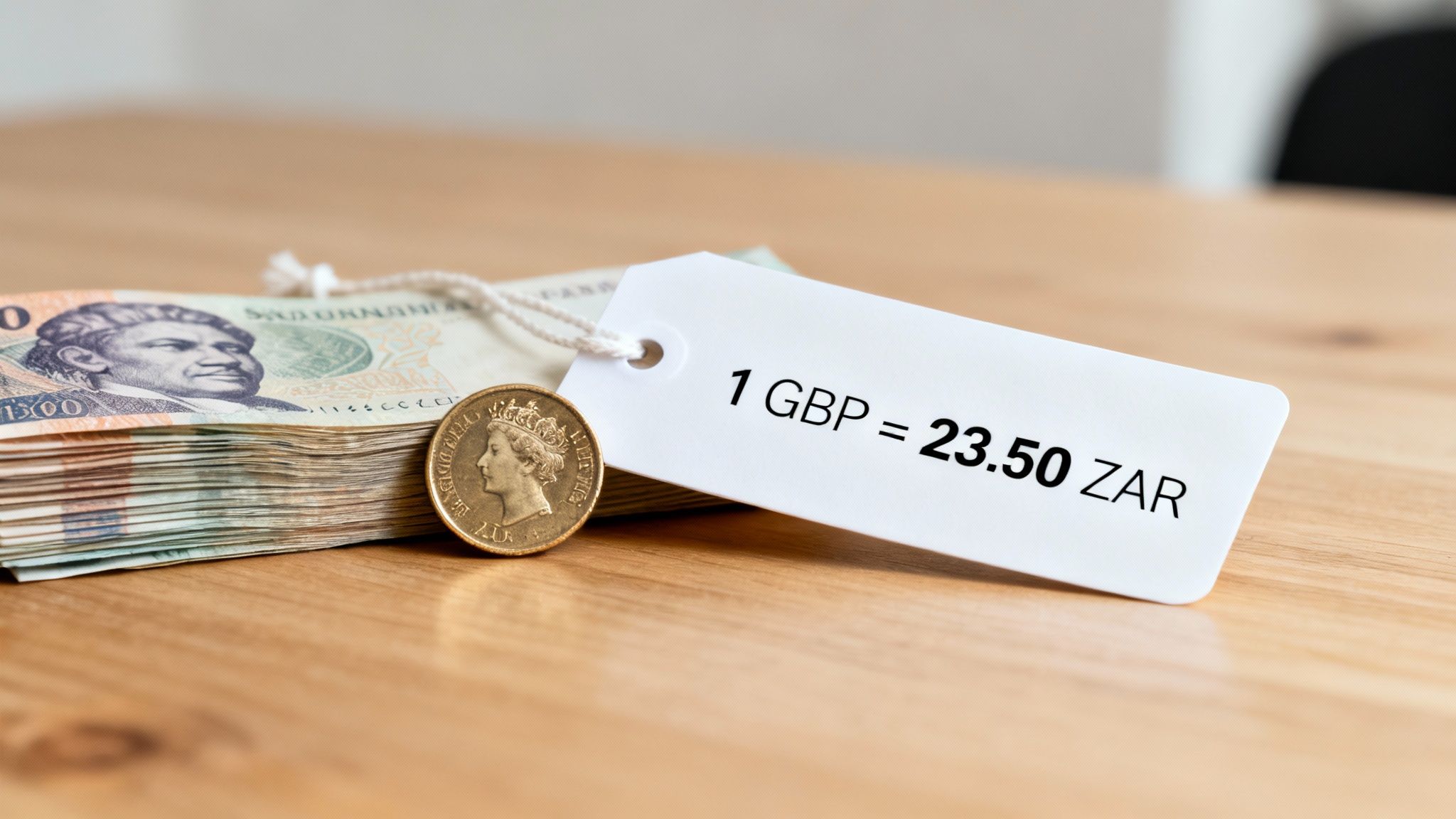
Picture the global foreign exchange (forex) market as a massive, non-stop auction. On one side, you have traders selling British Pounds, and on the other, you have buyers ready to snap them up using South African Rands. The GBP/ZAR exchange rate is the price they all agree on at any given moment.
But this isn't a fixed price. It’s alive, shifting constantly throughout the day in response to global events and economic news. The rate you often see quoted on finance websites or in the news is what’s known as the mid-market rate, or the interbank rate. Think of this as the wholesale price that major banks use when they trade huge currency volumes between themselves. For the rest of us—businesses and individuals—this rate is the benchmark from which our own rates are derived.
The Two Sides of the Exchange Rate
Whether a particular rate is "good" or "bad" is all about perspective. It completely depends on which currency you have and which one you need.
A Higher Rate (e.g., £1 = R25.00): This is fantastic news if you're holding Pounds and need Rands. Every Pound you convert stretches further. It’s ideal for a UK tourist arriving in Cape Town or a South African business that exports to Britain and gets paid in GBP.
A Lower Rate (e.g., £1 = R22.00): This works in your favour if you're converting Rands into Pounds. It means each Pound costs you fewer Rands, making it cheaper for a local company to import British machinery or for a family to pay for university fees in the UK.
At its heart, the exchange rate is a live snapshot of how the market feels about the economic health and stability of one country versus another. A moving rate isn’t a sign of chaos; it’s the pulse of a healthy, functioning global economy.
Key Terms for the Pound to Rand Rate
Getting to grips with forex can feel like learning a new language. This quick table breaks down some of the essential terms you’ll come across.
| Term | Simple Explanation |
|---|---|
| Base Currency | The first currency in a pair (in this case, GBP). It's always equal to one unit. |
| Quote Currency | The second currency in a pair (here, it's ZAR). It shows how much is needed to buy one unit of the base currency. |
| Mid-Market Rate | The "wholesale" rate, halfway between the buy and sell prices. It’s a pure benchmark, not a rate available to the public. |
| Bid Price | The price at which a broker or bank is willing to buy the base currency (GBP) from you. |
| Ask Price | The price at which a broker or bank is willing to sell the base currency (GBP) to you. |
| Spread | The small difference between the bid and ask prices. This is how currency providers make their profit. |
These terms form the foundation of any currency conversation.
Before we dive into the powerful forces that push and pull on this rate, it's vital to have these basics down. Understanding what the GBP/ZAR rate represents and how to read its movements is the first step toward making smarter financial decisions, whether you're running a business or managing your personal finances across borders.
Here’s the rewritten section, designed to sound completely human-written and natural.
How Is the Pound to Rand Rate Determined Daily?
You might think there's a committee somewhere or a big bank that decides the pound to rand rate each morning. The reality is far more dynamic. The rate is actually set by what’s known as a floating exchange rate, which is best imagined as a massive, non-stop global auction.
Think of it this way: currencies are being bought and sold every second of every day, all around the world. This market never sleeps. It’s a constant tug-of-war between buyers and sellers, from central banks and huge multinational corporations right down to individual investors and holidaymakers. Every single transaction, no matter how big or small, plays a part in shifting the balance between the supply of and demand for both the British pound and the South African rand.
A Never-Ending Global Auction
Let’s use a simple example. Say a large British company decides to build a new factory in South Africa. To pay for it, they’ll need to sell a huge amount of pounds to buy rands. That single move instantly increases the demand for ZAR and, at the same time, floods the market with more GBP.
This shift in the balance makes the rand a little more expensive compared to the pound, and the exchange rate adjusts on the spot. Now, imagine that effect multiplied by millions of similar transactions happening all day, every day.
- International Trade: When a South African company imports machinery from the UK, they need pounds, which drives up demand for GBP.
- Foreign Investment: If a UK-based fund buys shares on the Johannesburg Stock Exchange, they need to buy rands, boosting ZAR demand.
- Tourism: British tourists heading to Cape Town sell their pounds to get rands for their trip.
- Sending Money Home: A South African working in London who sends money back to family is selling pounds and buying rands.
Each of these actions nudges the supply and demand scales, causing the constant, real-time fluctuations you see when you check what the GBP ZAR exchange rate is.
The daily exchange rate is simply the price the market settles on. It’s the real-time result of millions of buyers and sellers across the globe agreeing on what one currency is worth in terms of the other, right at that moment.
The Big Players Making Waves
While every transaction has an effect, some players move the market far more than others simply because of the huge volumes they trade.
- Central Banks (The SARB and Bank of England): These institutions buy and sell currencies to manage their country's foreign reserves or to try and stabilise their own currency's value. Their actions can have a massive impact.
- Commercial Banks: They are the giants of the foreign exchange world, handling immense volumes for their corporate and individual clients every day.
- Investment Funds: These are the big money movers. When large funds decide to shift billions from one country to another to chase returns, they create serious waves in the currency markets.
- Corporations: Any business involved in importing or exporting is constantly in the market, buying and selling currency to pay suppliers and get paid by customers.
When one of these major players makes a big move, it can cause a noticeable ripple effect. For instance, if a global investment fund suddenly feels more optimistic about South Africa's economic future, it might pour billions into buying rands. That action alone could cause the ZAR to strengthen significantly against the pound. Understanding who the big players are is key to grasping why the rate you see one day can be so different the next.
The Economic Engines Driving the GBP/ZAR Rate
While the daily tug-of-war between supply and demand sets the immediate price, there are much bigger forces at play. Think of them as the powerful economic engines in both the UK and South Africa that steer the GBP/ZAR exchange rate over the long haul. Understanding these fundamental drivers is the key to connecting news headlines with the real-world value of your money.
These aren't just random, unpredictable movements. They’re the core economic indicators that signal a country's financial health, and they catch the eye of global investors who are constantly scouting for the safest and most profitable place to put their capital.
Interest Rates: The Currency Magnets
Imagine a country's interest rate as a powerful magnet for foreign investment. When central banks like the South African Reserve Bank (SARB) or the Bank of England (BoE) adjust these rates, they're sending a strong signal to the world.
If a country offers higher interest rates, it becomes a hotspot for investors chasing better returns on their money.
To get in on the action, they first have to buy that country's currency. So, if the SARB decides to raise interest rates while the BoE keeps theirs steady, international investors might sell Pounds to buy Rands. This surge in demand for the ZAR naturally causes it to strengthen against the GBP. The opposite is also true—lower interest rates can make a currency less attractive, often leading to a weaker exchange rate.
An interest rate decision is one of the most direct and powerful tools a central bank has. It sends a clear signal to the global market about the country's economic strategy, immediately influencing currency strength and the GBP to ZAR rate.
Inflation and Economic Growth
Inflation—the rate at which prices for goods and services rise—acts like a slow puncture on a currency's value. When inflation is high and out of control, it eats away at purchasing power. Simply put, your money buys less tomorrow than it does today, making the currency a lot less appealing to hold onto.
On the flip side, a country’s Gross Domestic Product (GDP) is a snapshot of its economic health and output. Strong, consistent GDP growth points to a thriving economy, which builds investor confidence. A healthy, growing economy is a magnet for foreign investment, which in turn helps prop up the value of its currency.
South Africa's Unique Driver: Commodity Prices
For South Africa, there's one economic engine that has a particularly massive influence: commodity prices. The country is a world-leading exporter of precious metals like gold, platinum, and palladium. What happens to these commodities on the global market has a direct and significant knock-on effect on the Rand.
Here’s how it works:
- When commodity prices are high: South Africa earns more foreign currency (like US Dollars or Pounds) from its exports. This flood of foreign cash, which must be converted into Rands to pay local costs, boosts demand for the ZAR and strengthens its value.
- When commodity prices fall: Export revenues shrink, slowing the flow of foreign currency into the country. This reduces demand for the Rand, often causing it to weaken against major currencies like the GBP.
This relationship is a crucial piece of the puzzle when you're trying to figure out what the GBP ZAR exchange rate is and where it might be headed.
The constant interplay of all these factors creates a complex and dynamic environment. For instance, data from late 2023 showed the Rand weakening slightly in the short term, yet it had actually gained strength over the preceding 12 months. This highlights the Rand's long-term resilience, even when facing immediate pressures. For businesses looking at opportunities in the region, a detailed UK Business Guide to Outsourcing in South Africa can provide excellent context on the broader economic landscape.
How Politics and Investor Confidence Shape the Rate
Currency markets don't just run on spreadsheets and economic data; they're driven by people. That means human emotion, perception, and confidence play a massive part in determining what the GBP ZAR exchange rate is on any given day. Political shifts in either the United Kingdom or South Africa can send powerful ripples through the currency pair.
Think of investor confidence as the weather forecast for a currency. A sunny outlook, filled with political stability and pro-business policies in South Africa, tends to attract a warm front of foreign capital. When investors feel good about a country's future, they buy Rands to invest in local assets, which naturally strengthens the ZAR.
On the flip side, a forecast of political storms—like policy uncertainty or social unrest—causes a cold snap. Investors get nervous, pull their money out, and the Rand weakens.
The Role of Market Sentiment
This collective feeling of optimism or pessimism is what we call market sentiment. It’s a powerful, and often unpredictable, force. A major UK election, for instance, can introduce a huge amount of uncertainty, causing the Pound to bounce around. In South Africa, something like a cabinet reshuffle can be seen by the market as either a step forward or a step back, hitting the ZAR almost instantly.
When global uncertainty is high, a "risk-off" sentiment often takes over. In this environment, investors tend to flee from what they see as riskier assets—like emerging market currencies—and flock to safe-haven currencies like the US Dollar or Swiss Franc.
"The Rand’s performance... was a study in contrasts. It was buoyed by commodity-linked optimism early in the month but battered midstream by geopolitics and rate differentials."
This 'flight to safety' means lots of ZAR gets sold off while demand dries up, putting downward pressure on its value against currencies like the Pound.
How Political News Creates Real-Time Swings
Political news has an immediate, real-world impact. Just think about these scenarios:
A Positive Development: Imagine the South African government successfully launches a new initiative to kick-start economic growth. Investor confidence could surge. This wave of positivity would likely lead to a rally for the Rand, causing the GBP/ZAR rate to fall as the ZAR gets stronger.
A Negative Shock: Now, picture some unexpected political turmoil brewing in the UK. This could easily erode confidence in the Pound. International investors might start selling their GBP assets, weakening the Pound and making the GBP/ZAR rate drop.
At the end of the day, economic fundamentals and political stability are two sides of the same coin. A stable political climate builds the confidence needed for an economy to thrive, which in turn attracts the foreign investment that underpins a strong, resilient currency.
Tracking and Interpreting the GBP/ZAR Exchange Rate
https://www.youtube.com/embed/9DVYVfI81R8
Knowing what makes the Pound to Rand rate tick is one half of the puzzle. The other half is knowing how to track its movements and make sense of what you're seeing. To truly grasp what the GBP ZAR exchange rate is at any given moment, you need reliable information and the skill to read between the lines. This is how you move from just seeing a number to understanding the story it tells.
The good news? You don't need a fancy trading desk. Top-notch, real-time data is surprisingly accessible. You can find it on major financial news sites, specialised forex platforms, and even straight from the source at the Bank of England and the South African Reserve Bank. These institutions offer live charts that act as your window into the market's heartbeat.
Reading the Story of an Exchange Rate Chart
When you look at a GBP/ZAR chart, you're not just looking at a line on a graph—you're seeing a visual history of its value. An upward trend means the Pound is getting stronger, and you’ll need more Rand to buy a single Pound. A downward trend signals the opposite: the Rand is gaining strength, making the Pound cheaper to acquire.
This is where perspective becomes everything. By zooming out and looking at trends over different periods—from a single day to several years—you start to see the bigger picture. Is the rate’s current dip just a blip in a longer-term rise, or is it part of a sustained decline? That historical context is essential for making smart decisions.
For a real-world example, just look at the six months between late April and October 2025. The GBP/ZAR rate took a significant tumble of roughly 7.73%, falling from a high of 24.892 to a low of 22.888. This sharp drop clearly shows the Pound weakening against the Rand during that period—invaluable information for anyone planning a transaction. You can dig into more of this kind of information by exploring the GBP to ZAR rate performance on exchange-rates.org.
This infographic neatly sums up the key forces—politics, investor confidence, and global risk—that drive these kinds of swings.
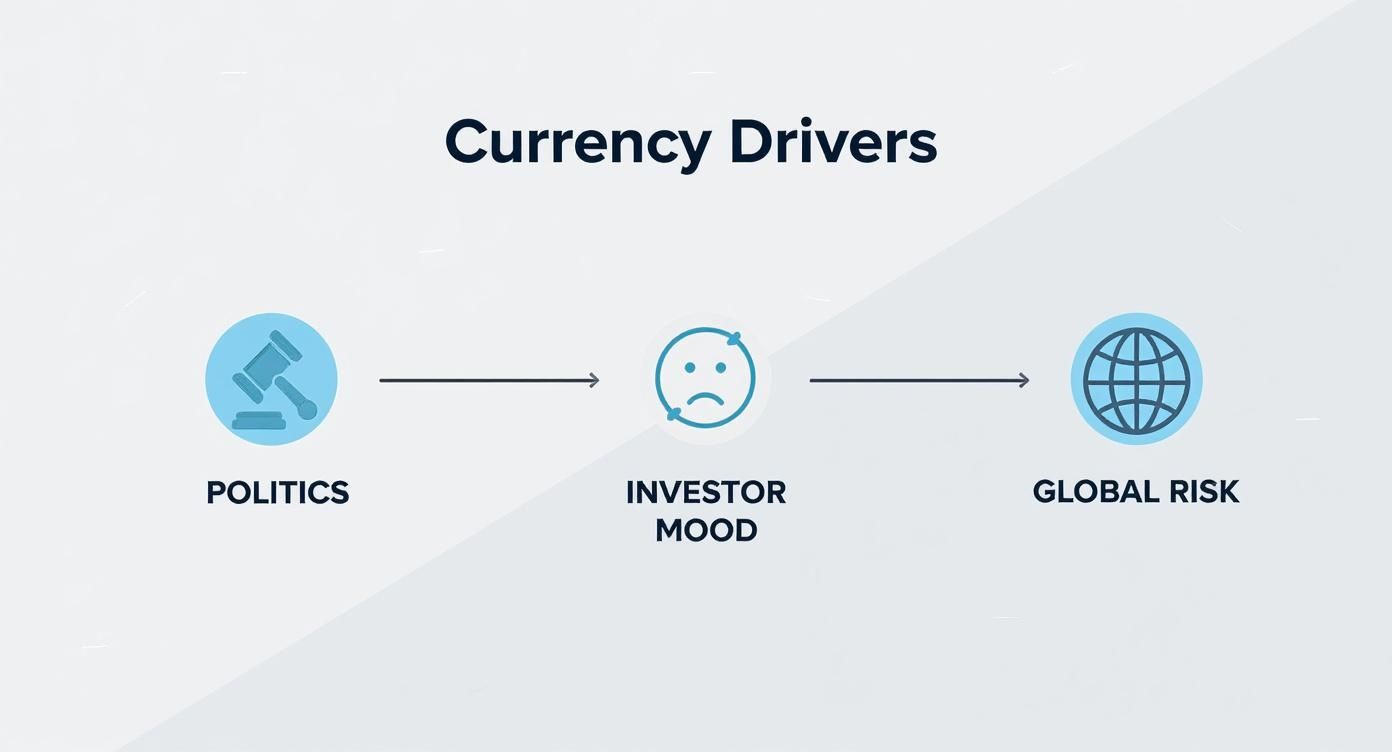
As you can see, factors that aren't purely economic often have the most immediate and powerful impact on an exchange rate.
Knowing the historical highs and lows gives you a benchmark to judge whether the current rate is a good deal. If today’s rate is hovering near a six-month low, it might be a great time for anyone needing to buy Pounds. If it's near a peak, those selling Pounds for Rand are in a much better position.
Recent GBP/ZAR Exchange Rate Snapshot (October 2025)
To see how much things can change day-to-day, let's look at some daily reference rates from the Bank of England. This table shows the typical fluctuations you might see within a single month.
| Date | GBP to ZAR Rate |
|---|---|
| 1 October 2025 | 23.015 |
| 2 October 2025 | 22.988 |
| 3 October 2025 | 23.102 |
| 6 October 2025 | 23.050 |
| 7 October 2025 | 22.954 |
| 8 October 2025 | 23.091 |
| 9 October 2025 | 23.150 |
| 10 October 2025 | 22.999 |
Even over just a couple of weeks, you can see the rate bouncing around. While the changes might seem small, they add up significantly on larger transactions, highlighting why timing your transfers can make a real difference to your bottom line.
What the Pound to Rand Rate Means for You

We've unpacked the big economic forces that nudge the Pound to Rand rate up and down. But let's bring it back to basics: how does this number, flickering on a screen, actually impact your business and your wallet here in South Africa?
The truth is, this isn't just an abstract figure for traders and economists. It has real, tangible consequences for anyone with ties to the UK, whether you're buying goods, sending money, or planning a trip.
The Impact on South African Businesses
For South African companies, the GBP/ZAR rate is a critical factor that can directly influence profitability. The direction the rate moves determines who wins and who loses in the cross-border trade game.
When you’re an Importer: A weaker Rand (meaning a higher GBP/ZAR rate) is tough news. If your business brings in goods, services, or even software from the UK, your costs suddenly shoot up. That same invoice in Pounds now costs you more in Rands, squeezing your margins or forcing you to increase prices for your customers.
When you're an Exporter: On the flip side, a weaker Rand can be a massive advantage. South African businesses selling to the UK find their products become more affordable and competitive for British buyers. Even better, when you bring those Pound earnings back home, they convert into a larger sum of Rands.
The exchange rate is a double-edged sword. A "strong" Rand isn't automatically good for everyone, and a "weak" Rand isn't always bad news. It all comes down to which side of the transaction you're on.
How the Rate Affects Your Personal Finances
The reach of what the GBP ZAR exchange rate is goes far beyond the boardroom. It plays a significant role in everyday life for families, students, and consumers.
Think about your budget and personal plans. For instance, historical data shows that during October 2023, the rate often fluctuated between 22.6 and 23.3 ZAR per GBP. That specific range has a direct impact on the prices you pay for British imports. You can explore these numbers for yourself by checking the historical GBP to ZAR daily rates on Pound Sterling Live.
When the Rand is weaker, here’s what it means for you:
- Receiving Money: If you have family sending you money from the UK, each Pound they send stretches further, giving you more Rands in your account.
- Online Shopping: That item you've been eyeing on a British website suddenly becomes more expensive at the checkout when the price is converted to Rands.
- Planning a Holiday: A dream trip to London will cost you more. Your hard-earned Rands simply won't buy as many Pounds for your hotel, meals, and sightseeing.
Getting to grips with these real-world effects is the first step to making smarter financial decisions.
Common Questions About the GBP ZAR Exchange Rate
Dipping your toes into the world of foreign exchange always brings up a few practical questions. When you’re dealing with the Pound to Rand rate, getting to grips with the details can make a real difference to your finances, whether you're running a business or just managing your own money. Let's tackle some of the most common queries with clear, straightforward answers.
What Is a Good GBP to ZAR Exchange Rate?
This is a great question, but the answer really depends on which side of the transaction you're on. Think of it this way: a "good" rate is all about perspective.
If you’re in the UK sending money home to South Africa, you want the exchange rate to be as high as possible. A rate of 24 ZAR to 1 GBP is fantastic because every Pound you send stretches further and converts into more Rands for your family.
But flip the coin. If you’re a South African business importing equipment from Britain, you’re looking for the opposite. A lower rate, say 22 ZAR to 1 GBP, is much more favourable. It means the Pound is cheaper for you to buy, which directly lowers your import costs. A smart way to gauge if the current rate is good is to check how it stacks up against the averages over the past few months.
How Can I Get the Best Pound to Rand Rate?
To get the most bang for your buck (or Pound, in this case), the first rule is to steer clear of convenience traps. Airport kiosks and high-street banks are notorious for their hefty fees and less-than-ideal rates.
Your best bet is to look at dedicated online money transfer services or specialist forex providers. They operate with much thinner margins, meaning their exchange rates are usually very close to the mid-market rate you see on Google, and their fees are far more transparent. A little bit of planning goes a long way, too—watching the rate for a few days can help you pounce when the market is in your favour.
Trying to predict exactly where a currency will go next is a fool's errand. There are simply too many moving parts, from economic reports and political news to the general mood of the global market. Analysts can give us educated guesses, but they are just that—guesses.
So what might push the Rand in the right direction? Keep an eye out for positive news about South Africa's economic growth, a rise in the price of key commodities like gold and platinum, or a stable political climate that makes international investors feel confident. These are often signs the ZAR could strengthen.
For any South African business, getting a handle on currency risk and paying the real exchange rate isn't just a "nice-to-have"—it's vital for your bottom line. Zaro cuts through the noise, offering international payments at the true spot rate with zero spread and no hidden fees. It’s time to move past the complexity and high costs of old-school banking. Discover how your business can save with Zaro.